

TikTok is where people decide what’s worth buying next. Influencers help them decide by showing the product in action, answering real questions, and building confidence to buy.
Agencies can generate influencer marketing ROI on TikTok without big follower counts or polished production — if the content proves value fast and earns engagement. And what seems like a lucky viral hit is usually the result of choices you can learn and apply.
In this guide, you’ll learn how TikTok influencers drive ROI differently, the creator behaviors and campaign setups that turn views into sales, and the moves agencies can use to brief creators, spot winners early, and scale what’s working.
TikTok decides how many people to show a video to based on performance, especially early watch behavior and engagement, not follower count.
That’s why creative choices matter more than audience size. In the first seconds, TikTok watches how viewers react: do they understand the point quickly, keep watching, and engage? Videos that deliver on the promise and match what people already watch tend to reach more people.
To fit the TikTok feed, keep it fast and obvious: make the point early, use tight pacing, and choose a familiar format like a quick demo, POV, before/after, storytime, or tutorial.
That’s where conversions start: people stay, save, comment, and click when they’re ready.
TikTok ROI does not come from polish or high production. It comes from relatability, speed, and cultural timing. Successful TikTok creators master all three.
TikTok creators don’t just show products. They sell proof in public, often through comments and follow-up videos that answer doubts in real time.
What does proof look like on TikTok?
This is how creator-led commerce becomes a system you can repeat.
On TikTok, people open the app to be entertained and to discover something new. They’re not always shopping, but they’re open to ideas. That matters because creators can introduce a product right when a viewer is thinking, “Wait, how does that work?”
Here is what makes that work on TikTok:
A typical TikTok conversion path often looks like this:
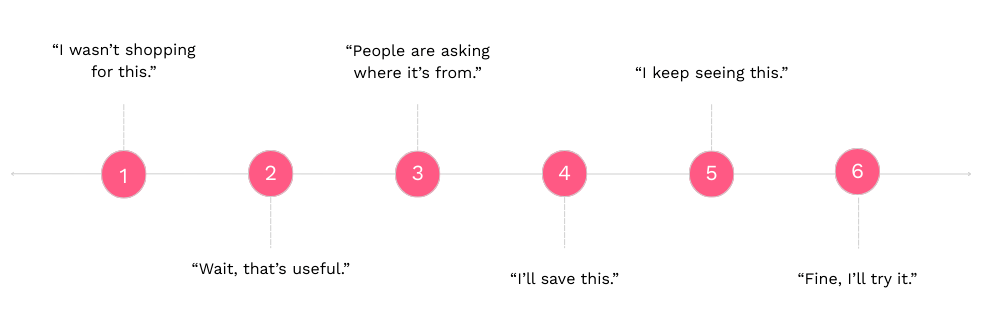
TikTok can create interest by letting people see proof and conversation build in public before they ever decide to buy. That’s different from demand capture, where someone already knows what they want and clicks an ad or a search result.
TikTok isn’t the only platform where creators drive sales. But the structure of intent is different.
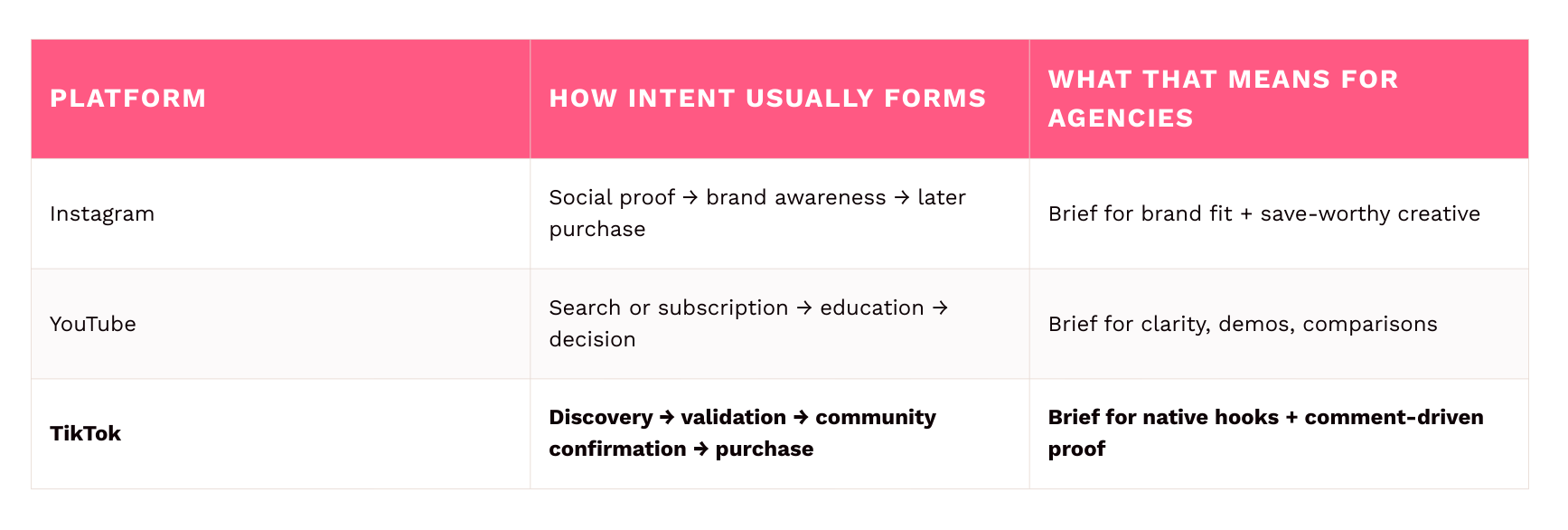
Why TikTok moves faster: it collapses inspiration + validation + distribution into one motion. A creator sparks interest, the comments and saves add proof, and the TikTok algorithm keeps the content circulating long enough for intent to mature.
On Instagram, many purchases start with “I follow this person and trust their taste.”
On YouTube, many purchases start with “I’m researching this and want a deeper explanation.”
On TikTok, purchases often start with “I did not know I needed this, but now I want to see if it’s real.”
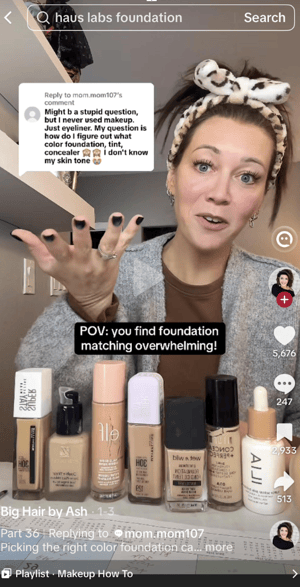
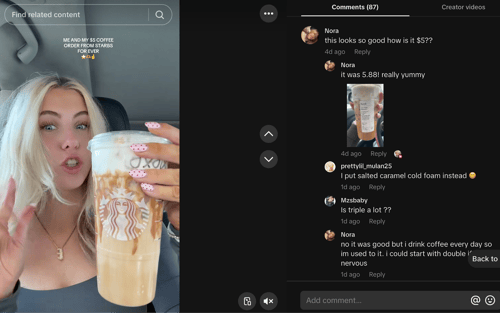
On TikTok, comments aren’t just reactions. They often answer the questions the video didn’t, and those answers live in public where everyone can learn from them.
In practice, the comment section often becomes the second half of the ad:
You’ll often see comment threads move in this direction:
Each question does real work. It signals intent, builds proof through real opinions, and keeps the video active longer as the thread continues to grow.
A practical way to think about it:
That’s why TikTok comment threads can act like mini sales funnels. They turn curiosity into answers, and answers into confidence.
Below are five creator patterns agencies can learn from. Watch how creators make proof visible in a way that drives real buying behavior.
Alix Earle converts through casual “get ready with me” storytelling. Products sell because they show up inside a routine and sound like a real recommendation, not a scripted placement.
Agency takeaway: Brief for the routine and the outcome (what the product helps with). Let the creator choose the words and the moment it appears.
Keith Lee can drive immediate sell-outs because viewers trust him. His reviews work because they feel consistent: what he ordered, what it cost, what happened, and a clear verdict.
Agency takeaway: Pick creators whose audience trusts their judgment. Build the brief around credibility signals (real ordering, clear verdict, tradeoffs), not hype.
Mikayla Nogueira drives launch-day conversion with fast demos and strong opinions. She explains what to look for and why it matters, not just how the product looks on camera.
Agency takeaway: Ask for proof of one or two specific claims on video (wear time, coverage, ease of use). “Looks good” is not enough—show what changes and why.
Chris Olsen makes integrations feel like sketches, not ads. That lifts shares and recall, which is useful when the same creative is later used for retargeting or paid amplification.
Agency takeaway: Treat entertainment-first integrations as top-of-funnel fuel on purpose. Plan paid amplification and retargeting from the start so the “memorable” creative can still drive measurable action.
Micro and mid-tier creators often drive strong Amazon and DTC results because their audiences are tighter and more specific. They may have fewer views, but the viewers are often closer to the problem the product solves.
Agency takeaway: Treat micro and mid-tier creators as a core conversion channel, not “testing only.” Brief them to prove the product in a specific use case, then scale the winners with paid support.
Organic UGC turned into a global shopping behavior and a repeatable pattern: discovery, questions, proof, purchase.
What to copy: Seed creators early and let the community scale it.
The mascot plus creators created cultural relevance and high engagement.
What to copy: Let creators riff on brand tone instead of enforcing rigid guidelines.
Everyday creators showcased real use cases that translated to sell-outs.
What to copy: Choose creators who already use similar products so the demo feels natural.
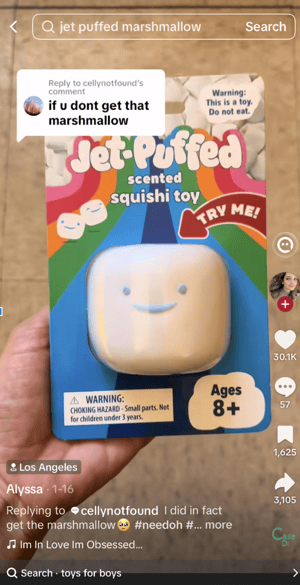
Budget products go viral because creators answer questions in comments at scale.
What to copy: Enable creators to answer “Where did you get this?” instantly.
Organic creator videos amplified with paid often outperform brand-shot ads.
What to copy: Test organic creator content first, then put spend behind proven formats.
TikTok ROI is cumulative, not instant. It builds through repeated discovery, validation, and community reinforcement.
Creator content introduces products naturally inside the feed. Engagement through comments and saves signals interest. Rewatches are another strong interest signal because TikTok heavily weights watch behavior when deciding what to show more people.
Conversion often happens after multiple exposures, through TikTok Shop, links, or comment-driven purchasing. The highest-performing brands treat TikTok as a momentum loop, not a funnel. Each interaction increases the likelihood of future conversion. One video rarely drives ROI alone. Patterns do.
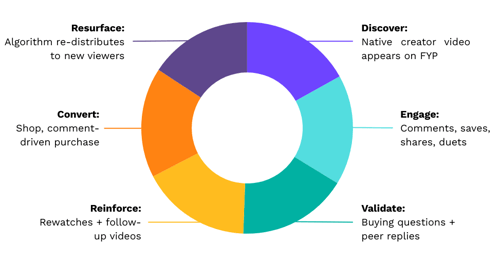
“TikTok ROI builds through a momentum loop. Repeated exposure creates certainty.”
Track TikTok trends weekly. Identify hooks, sounds, formats, and structures gaining momentum. Do not brief TikTok influencers from a static content calendar.
What to track:
Strong TikTok influencer campaigns do not start with brand language. They start with a creator’s natural voice.
Include:
Avoid:

Plan for creator-led commerce and paid amplification from day one.
Do this up front:
Do not judge TikTok ROI by reach alone.
Track:
Avoid:
Learn how Starbucks reads TikTok analytics and turns it into the next brief.
TikTok creators are redefining influencer marketing ROI because they create culture, build trust, and move product without looking like ads.
For agencies, the opportunity is clear: Build systems around creators, not control around them.
When you treat TikTok as a momentum loop, you stop betting on one viral moment and start building repeatable performances.
If your team is still measuring influencer success by reach and follower count, TikTok is going to feel unpredictable. If you measure the right signals and build briefs that let TikTok creators create proof, ROI becomes far easier to repeat. Explore how Influencity helps agencies find the right creators, track performance signals, and scale what works.
TikTok Influencers can drive Influencer Marketing ROI because TikTok rewards predicted interest, not follower size. If viewers watch, rewatch, save, and comment, the platform shows the video to more people. A smaller creator can outperform a larger one when the content proves value fast and sparks real engagement.
The strongest conversion signals are watch behavior and high-intent engagement. Track completion rate, rewatches, saves, shares, and comment activity (especially buying questions). These signals help TikTok decide whether to keep distributing the video and who to show it to next.
On TikTok, comments often turn into a public Q&A. Viewers ask “Is it worth it?” and “Where did you get it?” and creators or other users answer right there. That extra proof and clarification can push someone from curiosity to confidence without leaving the feed.
Brief TikTok influencers around a real use case and one or two product claims to prove on camera. Give creators freedom to use their voice, but be clear on what must be shown (how it works, for who, and any limits). Also plan for comments: include prompts that invite questions and make it easy to answer “Where can I buy it?”
Demand capture targets people who already want something and are ready to click, like in search. Intent building happens earlier: TikTok creates interest through discovery, proof, and public conversation. Many purchases start because a viewer sees a product used, validated in comments, and repeated across multiple videos.







%20and%20How%20Can%20They%20Benefit%20Your%20Brand%20article.jpg?length=628&name=What%20Are%20Key%20Opinion%20Leaders%20(KOL)%20and%20How%20Can%20They%20Benefit%20Your%20Brand%20article.jpg)





.png?length=628&name=Pop-up%20image%201200%C3%97800@1x%20(1).png)