

Influencer reach is only useful when it guides choices.
Most teams still total impressions and call it reach, which inflates results and hides waste. This playbook turns reach into a decision metric you can plan, optimize, and defend. You’ll count people once with Net Unique Reach, set Effective Frequency so messages stick, and track CP1K-U so cost reflects real people, not repeats. With a simple formula and a compact reporting format, you’ll compare creators fairly, grow a net-new audience, and show outcomes a CFO will trust.
Reach is the number of unique people who saw your content at least once. Social platforms label it differently. The idea is the same.
When you want a cross-platform total, you cannot add platform reach blindly. People overlap across TikTok, Reels, Shorts, and across organic and paid. You need a deduped total.
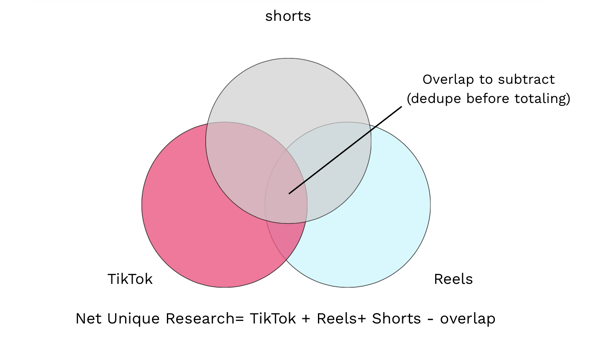
TL;DR: Count people once.
.png?width=600&height=218&name=Tabla%20Cuadro%20Comparativo%20de%20Resultados%20Simple%20Profesional%20Verde%20y%20Blanco%20(5).png)
Why this makes “reach” meaningful again
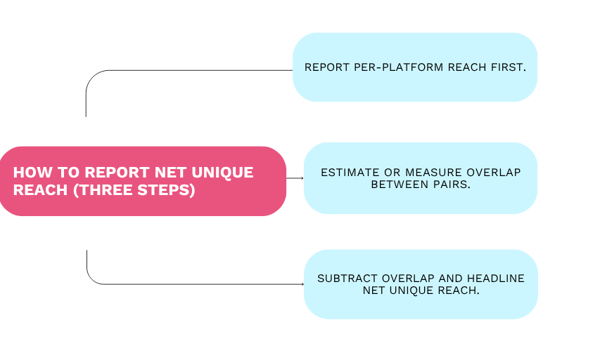
Note: If you have a report that already removes duplicates, use it as the source of truth. Examples include Google’s CM360 Unique Reach or Meta Reach & Frequency and Experiments. If you do not have deduped reports yet, label overlap as an estimate for now and replace it with measured numbers after the flight.
Efficiency metric: CP1K-U = Spend ÷ (Net Unique Reach ÷ 1,000)
This is more honest than CPM because it reflects different people reached, not repeats.
Bottom line: For awareness, optimize to Net Unique Reach + Effective Frequency. Use Engagement Rate to choose what to amplify, not as your headline number.
What each metric is good for
How to use them together
Bottom line: Use organic to find winners. Use 'paid' to scale winners to new people, while capping frequency so you don't pay for repeats.
When organic wins
When paid wins
Best-of-both workflow (three weeks)
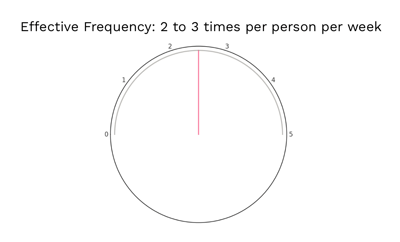
One post cannot carry awareness. A tiered creator mix takes the same idea through creators of different sizes so you reach new pockets of people instead of the same followers twice. That is how portfolios raise Net Unique Reach while keeping Effective Frequency in the sweet spot.
What each tier adds
Portfolio pattern: Anchor → Amplify → Swarm
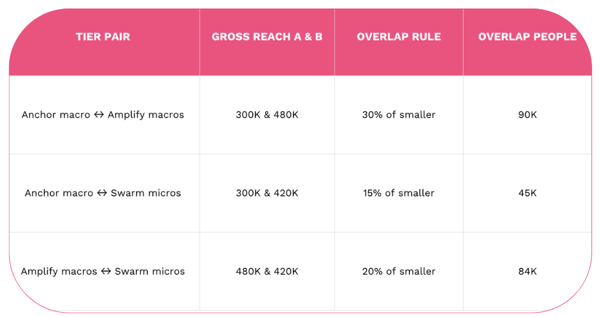
Net Unique Reach ≈ 300K + 480K + 420K − (90K + 45K + 84K) = 981K
This portfolio adds about 681K net-new people versus the 300K anchor alone.
Why this works: different tiers sit on different audience graphs, so overlap is lower between clusters. Using multiple creators also allows you to rotate openings and hooks to refresh frequency without bombarding the same people.
Pull these numbers first. Then dedupe to report Net Unique Reach.
Threads can be a light amplify channel. Do not make it central to reach planning.
Goal: estimate overlap for planning, then replace with measured numbers from social platform reports.
Rule tip: Apply the overlap percentage to the smaller of the two reach numbers in each pair everywhere. This prevents over-deduping.
Planning ranges to start with
Back-out math when you have a deduped total
Keep an Overlap Log
Simple table: Pair, audience and geo, window, Reach A, Reach B, deduped total, overlap people, overlap percent, notes. Your next forecast can use measured priors, not guesses.
TL;DR: estimate conservatively, document the smaller pool rule, then swap in CM360 Unique Reach or Meta Experiments numbers after the flight.
Posts do not reach new people on their own. Social media platforms push a post to look-alike audiences when it earns the right signals: strong watch time, saves, shares, and early comments. Reposts, duets, collab posts, and paid whitelisting also place the same idea in other people’s feeds. The tips below focus on creating those signals and removing friction so your best ideas travel farther for the same budget.
Formats that naturally multiply
Why it helps NUR: copyable formats spread into new networks, not just more impressions to the same followers.
Hook and structure you can repeat
Example hooks to test
“I tested three mascaras. Only one did not smudge.”
“Five minute desk routine that stops 3 p.m. shine.”
“The twelve dollar gym bag swap that actually works.”
Repurposing map: one idea to many doors
NUR tip: every repurpose is a chance to reach a different audience cluster. Track per-platform reach first. Then dedupe.
Find winners fast, then scale
Keep your summary to one page. Show per-platform numbers, show your overlap once, then headline Net Unique Reach with Effective Frequency and CP1K-U.
1) Per-platform inputs
Platform | Spend | Reach (people) | Impressions
TikTok | $___ | ___ | ___
Instagram (Reels/Stories) | $___ | ___ | ___
YouTube (Shorts) | $___ | ___ | ___
Totals | $___ | ___ | ___
If a channel lacks reach, use “Unique viewers” as a proxy and label it clearly.
2) Overlap (single line)
Total overlap (people): _____
If you do not have deduped reports yet, enter your best estimate and label it.
3) Headline box
Net Unique Reach (NUR): _____ people
Effective Frequency (EF): _____ (target near 2–3 per person per week)
CP1K-U: $_____ = Spend ÷ (NUR ÷ 1,000)
One-liner you can put on the slide:
We maximized Net Unique Reach at an EF near 2 to 3 per person per week. Efficiency reported as CP1K-U.
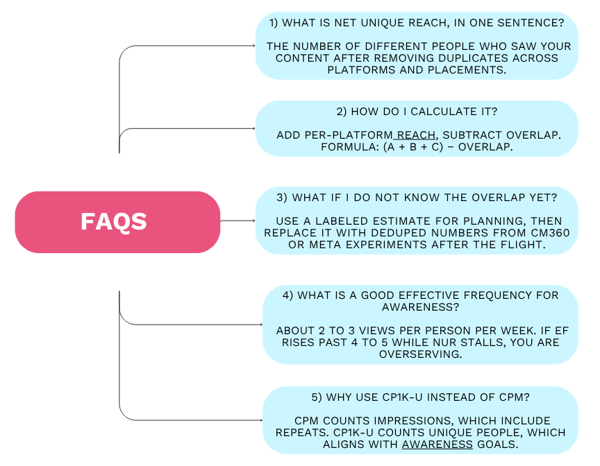
Lead with Net Unique Reach. Show Effective Frequency and CP1K-U alongside it so reach becomes actionable. Post-level reporting helps you pick creative winners; creator-level reporting guides which partners to invest in; and the campaign one-pager proves impact without double-counting. Over time, replace overlap estimates with measured, deduplicated numbers, so forecasts become sharper with each flight. The outcome is simple: more new people reached the right number of times, with less waste and clearer decisions.








%20and%20How%20Can%20They%20Benefit%20Your%20Brand%20article.jpg?length=628&name=What%20Are%20Key%20Opinion%20Leaders%20(KOL)%20and%20How%20Can%20They%20Benefit%20Your%20Brand%20article.jpg)