

Every marketer knows the biggest challenge in influencer marketing: proving ROI.
We’ve all been there. You sign a promising contract, hope for the best, and only measure the outcome weeks later, when it’s too late to change anything.
The good news is we can now forecast ROI before we sign. We have better benchmarks, deeper analytics, and clearer ways to connect influencer activity to business outcomes. By forecasting influencer marketing ROI, you can estimate ROI, evaluate multiple scenarios, and improve your likelihood of success before you spend a dime.
In this guide, I’ll show you how to:
By the end, you’ll have a practical framework to decide what to sign, what to adjust, and what to walk away from.

Before you build a forecast, take one step back.
Does your campaign type match what you’re trying to achieve?
One of the biggest mistakes I see is brands setting goals that don’t line up with the campaign objective. You can’t run an awareness campaign and expect direct sales. You can’t run a conversion-focused campaign and treat impressions as the success metric.
Here’s the simplest way to keep goals and campaign types aligned:
Need inspiration on setting goals for your influencer activations? Our guide on setting SMART goals for influencer marketing can help.

The basic ROI formula is straightforward:
ROI = (Revenue Generated – Campaign Cost) / Campaign Cost
That formula is useful, but it can also create false confidence. Influencer marketing ROI doesn’t always show up as immediate revenue. It can show up as:
So for forecasting, it helps to think in two lanes:
Performance ROI
This is the revenue and conversion side: sales, leads, cost per acquisition, and cost per outcome.
Value ROI
This is the business value that supports performance: qualified reach, audience fit, engagement quality, content reuse value, and brand impact.
Influencer ROI can show up across the customer journey. A conversion campaign is judged differently from an awareness or retention effort. Forecasting starts by choosing the stage you’re trying to influence.
If you want a simple way to separate “good to know” metrics from metrics you can defend in a budget conversation, this guide helps.

Before approval, you can already pressure-test whether a campaign has a realistic path to success. The goal isn’t to predict the exact result. It’s to confirm that the inputs behind your ROI forecast are solid enough to defend.
Attribution Comes Before Forecasting Conversions
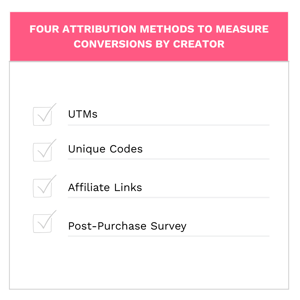
If conversions are part of your forecast, make sure you can measure them. This is where plans often break: teams estimate revenue impact, sign contracts, and only later realize their tracking cannot connect results back to creators. Confirm at least one of these is in place to measure conversions before launch:
You don’t need every method. You just need one you trust.
Your ROI forecast will be off if the cost side is incomplete.
Creator fees are rarely the full investment, yet they’re often the only number used in early ROI calculations. That inflates forecasts and makes post-campaign reporting harder to defend.
Before signing, outline what “campaign cost” really includes:
You don’t need perfect precision. You need a realistic estimate.

A forecast is only useful if it helps you make a decision before you commit to spending. If your forecast can’t answer “should we do this?” it’s just a spreadsheet.
This framework keeps the work focused on pre-contract clarity: what you’re trying to achieve, what inputs you can defend, and what changes you can make while you still have leverage.
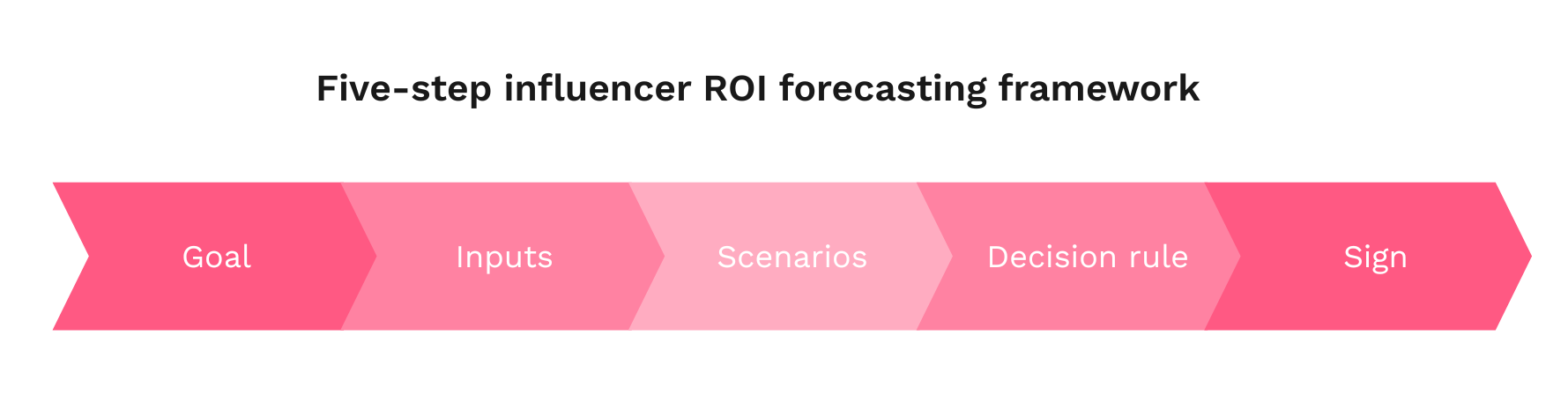
Choose one primary ROI driver. This is the outcome you will report upward and use to defend the spend.
If you try to forecast everything at once, you’ll end up with a model that looks sophisticated but can’t guide a decision.
Work backward. Define what has to be true for the campaign to hit the goal.
At minimum, capture:
Before contracts are signed, build at least three options and compare them:
This is where Influencity’s estimation view helps. You can compare creator mixes and see how expected reach and spend shift by platform and activity type.
For your chosen plan, model:
Then write one sentence that becomes your guardrail: If the conservative scenario doesn’t clear our minimum return, we don’t sign.
If the forecast doesn’t work, don’t default to “cancel.” Forecasting is valuable because it shows what to adjust while you still can.
Common levers to test before signing:
A forecast should end with a decision: sign as-is, renegotiate, redesign, or walk away.

Influencity’s estimation feature helps you forecast reach and budget distribution based on:
It’s useful during planning because it shows:
What it can’t do on its own is guarantee conversions. That’s where your tracking setup, offer quality, creative fit, and audience alignment decide how much of that reach turns into business results.

Forecasting isn’t only about finding creators to say yes to. It’s about protecting your budget from deals that look exciting but won’t deliver what you need.
Teams hesitate here because saying no feels like slowing momentum. But walking away early is far easier than defending weak results later. And when you’re forecasting, you’re not rejecting a creator as “bad.” You’re rejecting a fit that doesn’t support your goal.
Here are the most common warning signs to look for before contracts are signed.
If your offer is U.S.-only and the creator’s audience is heavily outside the U.S., forecasting conversions becomes unrealistic. The same goes for age range and interest alignment.
Look for performance that is consistently strong, not just occasional spikes. Sudden follower jumps, unusually high engagement that doesn’t align with views, or erratic patterns can signal that results won’t be predictable.
If you want a clean checklist of what to watch for, this guide covers practical red flags without overcomplicating it:
The deliverables don’t match what the creator is good at
A creator may look like a great fit, but the plan forces them into a format that isn’t how they perform best. When format fit is off, forecasts get shaky fast.
Even when a creator is aligned, the price can still break the forecast. If your conservative scenario only works if everything goes perfectly, that’s a signal.
One simple guardrail helps: write down what result would make you walk away before you sign.
Saying no is not the cautious move. It’s often the most ROI-positive decision you’ll make.

It’s tempting to ask, “Which platform has the best ROI?” The problem is that platform ROI isn’t a fixed number. It changes based on your category, creative, audience, and what you’re trying to achieve.
A better question is: Which platform is most likely to deliver the outcome you’re forecasting?
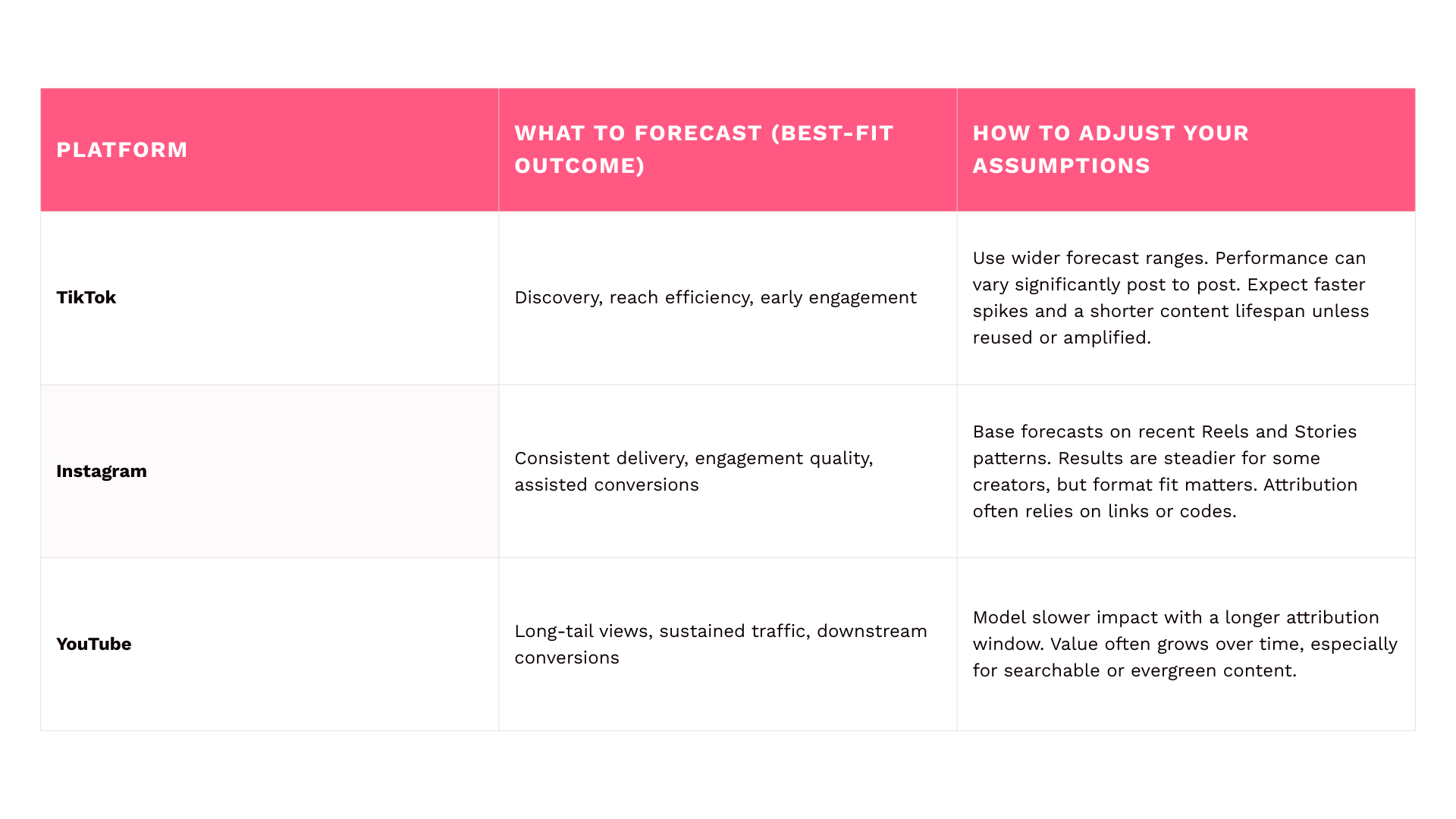
Instead of applying one average ROI rate across channels, forecast each platform using the same inputs:
If you’re stuck, pick one primary KPI per platform, forecast three scenarios, and compare the conservative case first. That’s where risk shows up.

Use this checklist right before approval, when you can still adjust the plan.
If conversions are part of the forecast:

A forecast won’t remove risk. But it helps you control it before you commit budget. Build a conservative scenario using one KPI and one alternate creator mix. Write down your assumptions. If the conservative case still holds up, you can sign with confidence.









%20and%20How%20Can%20They%20Benefit%20Your%20Brand%20article.jpg?length=628&name=What%20Are%20Key%20Opinion%20Leaders%20(KOL)%20and%20How%20Can%20They%20Benefit%20Your%20Brand%20article.jpg)






.png?length=628&name=Pop-up%20image%201200%C3%97800@1x%20(1).png)