

Influencer recruitment is where even well-planned campaigns lose the most time. The brief is barely approved before you’re scrambling through creator searches, unanswered DMs, scattered screenshots, and spreadsheets that are already outdated by the time you save them.
It’s overwhelming, chaotic, and it makes every launch feel rushed, even when you planned ahead.
This guide shows you how to fix that. You’ll learn how automating workflow in influencer recruitment turns all that manual admin into a clean, predictable process, so qualified creators come to you, and approvals stay organized. You move from brief to shortlist without the panic, bottlenecks, or lost opportunities.
Influencer recruitment should feel like matching, not chasing. But for most teams, it’s the slowest and most unpredictable part of the process. You start every campaign by searching from scratch, scanning profiles, manually checking metrics, and sending cold DMs that often go unanswered. Even when creators respond, half the information arrives in screenshots or long email threads that disappear the moment the next brief comes in.
The real bottleneck isn’t a lack of talent. It’s the process behind discovering and vetting that talent. When information lives across inboxes, chats, spreadsheets, and personal notes, it becomes almost impossible to keep a clear view of who applied, who fits the brief, and who is still waiting on a response. Teams spend hours each week sorting through messages, moving data from one place to another, and trying to rebuild shortlists that were only agreed on in conversation a few days earlier.
For many teams, recruiting and vetting creators eats up more hands-on time than planning, content review, and reporting combined. Launch dates slip, creators lose interest, and clients grow anxious because the shortlist isn’t ready. And, because the process is largely manual and unstructured, each campaign starts from scratch.
This means a lot of repetitive manual work: hunting for profiles, copying handles into spreadsheets, asking for screenshots of insights, chasing missing details in DMs, and trying to remember who you already contacted. Most of these steps don’t need human judgment. They’re just the steps you take before you can make a shortlist.
That’s exactly the part of the workflow that automation should handle.
Automation can sound like replacing people, but in influencer marketing, it should do the opposite. Automating workflow in influencer recruitment is about removing the steps that don’t benefit from human intuition, so your team can spend more time on strategy, relationships, and creative direction.
In practical terms, automating the workflow here means:
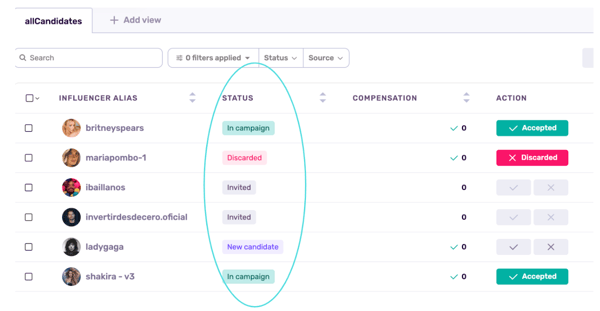
Instead of reinventing your process for every campaign, you run a system that works the same way every time.
The recruitment phase is the biggest opportunity because it’s high-volume and low judgment. Once this part is structured, everything after it, from approvals, negotiations, content review, and reporting, gets easier.
Automation doesn’t choose creators for you. It standardizes how applications come in, how data is captured, and how you filter options. Your team still decides who is the best fit, negotiates terms, and manages the relationships. The software simply clears the busywork that slows you down.
Once you decide to start automating your recruitment workflow, the next question is how. The answer isn’t just to speed up what you’re already doing. It’s to rethink how brands and agencies attract creators in the first place.
Influencity Casting Calls are built around that idea.
A Casting Call is a public, branded campaign page, published as a unique link, whose goal is to attract, qualify, and organize interested creators in one place. Creators click that link to view all the key information (i.e., campaign objectives, deliverables, deadlines, compensation, and legal terms) and then submit an application through your form.
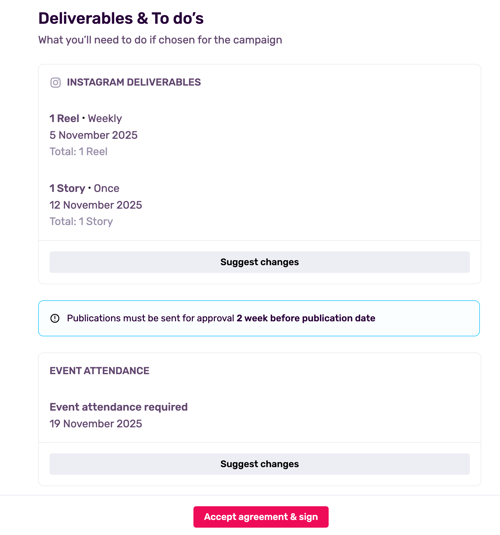
Instead of you hunting for creators one by one, you publish a single campaign link that many creators can see and apply through. That link becomes the front door to your campaign.
Creators can reach your Casting Call in three main ways:
You decide which details creators must provide: social handles, contact info, audience location, niche, content examples, and custom questions. All fields you choose are mandatory, so every application arrives complete and comparable.
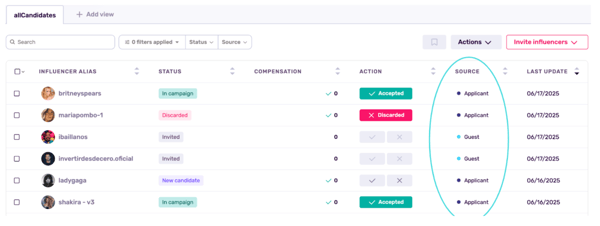
As applications come in, they appear in your Casting Call dashboard. You can accept or reject candidates with a single click. Accepted creators move into your campaign workflow and IRM, where you can continue managing deliverables, payments, and relationships.
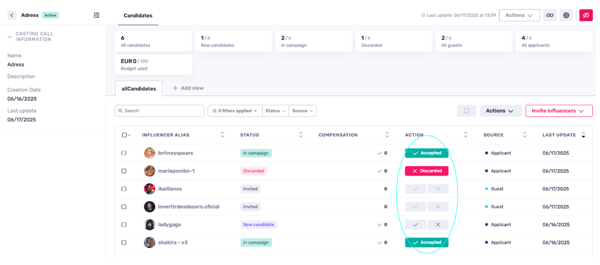
From there, you evaluate applicants using the metrics already available in Influencity: engagement rate, audience demographics, authenticity checks, and content fit.
What gets automated with Casting Calls:
What stays human:
Casting Calls turn recruitment from a scattered set of messages into a simple, consistent process. It gets easier each time you use it, and it starts with interested, qualified applicants instead of a long list of maybes.
Casting give everyone involved in your influencer campaigns a cleaner system to follow and a setup that’s much easier to scale as you grow.
Every application adds to your internal knowledge. As you accept creators, they are added to your ongoing campaign workflows and can be referenced in your broader creator management. Over time, you build an organized pool of creators already matched to past briefs, brands, and formats, much more powerful than a static spreadsheet.
The more you use Casting Calls, the less cold outreach you need. New campaigns can start by activating the network you’ve already built, and you only reach out to fill true gaps, like new countries or niches.
Agencies juggling multiple brands can run several Casting Calls at once, each with its own branding and brief. You can:
This gives you oversight of every brief and program without needing to chase each individual conversation.
For brands running their own campaigns, or collaborating with agencies, Casting Calls provide:
For creators, a Casting Call is the opposite of a vague DM. They get:
That clarity respects their time and makes collaborations feel more professional from the start.
Casting Calls act as lightweight campaign architecture: faster launches, cleaner matchmaking, and fewer bottlenecks for agencies, brands, and creators.
Casting Calls are flexible enough to support almost any influencer program.
Global agencies often manage launches across multiple markets, with specific requirements for audience location or language. Instead of rebuilding outreach every time, they:
Shortlists that used to take two weeks can now be built in a few days.
E-commerce brands use Casting Calls to turn fans into ambassadors. They:
Because applicants already know the brand, content tends to be more authentic and easier to brief.
Talent managers use Casting Calls to standardize intake across multiple clients. Instead of managing submissions across forms and inboxes, they:
Teams using Casting Calls report outcomes such as:
Different use cases, same pattern: less manual outreach, more qualified applicants, and faster shortlists.
Once you’ve run your first Casting Call, the goal is to move from “one-off recruitment” to “always-on network building.” A few simple habits help.
Start with your non-negotiables: platforms, audience location, language, vertical, and minimum performance thresholds. Build these into your brief and required fields so creators can self-filter and save everyone time.
Treat your Casting Call as part of your marketing. Use visuals and copy that reflect the brand you represent. A polished, clear page attracts creators who take the opportunity seriously.
Use simple templates to close the loop with creators: accepted, shortlisted, waitlisted, or not the right fit this time. It protects your reputation, reduces ghosting, and makes it easier to re-engage great applicants later.
Every application is a potential fit for a future project. Tag creators by brand, region, content format, or campaign type. When a new brief lands, you can filter your existing network first and only supplement with new outreach where needed.
Here’s how traditional recruitment compares to a Casting Call workflow:
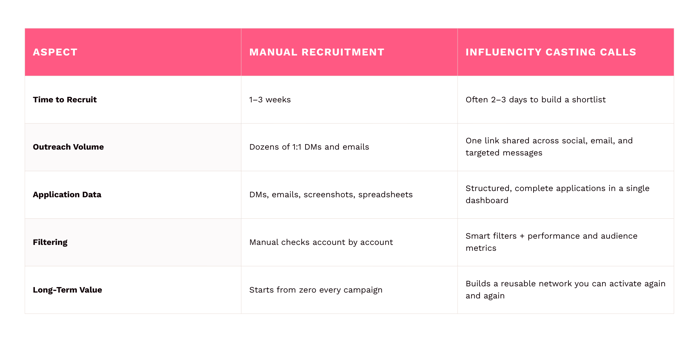
The biggest difference is momentum. Manual workflows slow everything down at the exact moment you need speed. Casting Calls accelerate everything by centralizing information and giving your team a reliable system to work from.
You don’t need to redesign your entire process to start automating your recruitment workflow. You simply structure what you already do.
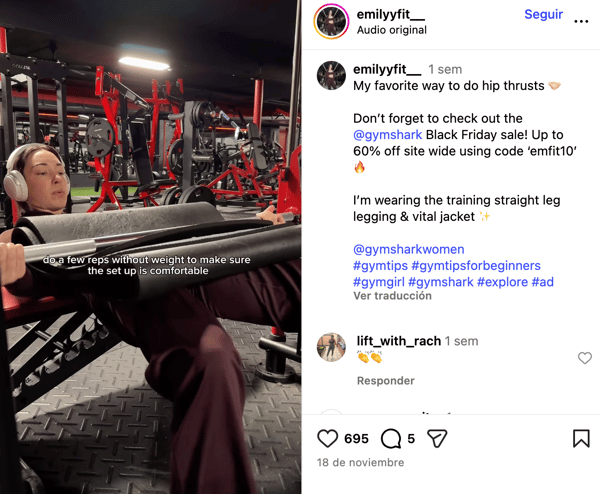
Manual influencer recruitment may be a comfort zone, but it slows teams down and forces every campaign to start from zero. Automating workflow in this stage doesn’t replace human judgment. It frees it up. Software handles the repetitive, admin-heavy tasks, so your team can focus on what they’re best at: strategy, selection, and relationships.
Casting Calls make that shift possible. They give creators a clear, professional way to apply, give your team structured data from day one, and give clients more confidence in how shortlists are built.
If you want recruitment to feel more like curating and less like chasing, this is where to start. Automate the parts of the workflow that don’t need human judgment, and reserve your creative and strategic energy for the decisions that do.








%20and%20How%20Can%20They%20Benefit%20Your%20Brand%20article.jpg?length=628&name=What%20Are%20Key%20Opinion%20Leaders%20(KOL)%20and%20How%20Can%20They%20Benefit%20Your%20Brand%20article.jpg)