Music and Third-Party Assets


Influencer marketing contracts often leave one massive blind spot: influencer content rights. Who owns the videos after the campaign ends? Can you reuse them in paid ads? What happens if a creator deletes the post, limits access, or repurposes the same footage for another brand?
In 2026, these questions show up fast because content moves fast. Teams clip a Reel into a TikTok ad or email. They drop creator videos onto product pages. They test new hooks weekly. Meanwhile, creators are protecting their own libraries, and platforms keep changing what “permission” looks like.
I’ve watched agencies lose access to top-performing assets because rights were never secured beyond the posting window. I’ve also seen brands run creator videos in ads without clear approval, then scramble when the creator calls it out publicly. It’s what happens when the contract lags behind how you plan to use the content.
Often, the reuse plan sits with the ads or ecommerce team, while the contract only covers the post. That mismatch turns into delays, rushed renewals, and conflict right when content starts working.
In this guide, I’ll cover what most contracts include, what they miss, and how to plan reuse without creating tension with creators.
If you’re investing real budget in creators, you’re not paying for one post and moving on. You’re paying for creative you can reuse across ads, email, and product pages. That only works when the reuse plan is written down early.
When influencer content rights are unclear, your best video becomes “hands off.” Teams want to reuse it, but no one can confirm what’s allowed. The team running ads either pauses to avoid a mistake or launches and hopes it’s fine. Then you circle back after the content proves it works, and expanding rights becomes a harder, more expensive conversation than it needed to be.
Clear rights keep campaigns moving. They also keep creator relationships cleaner, because expectations were set before performance raised the stakes.
Some brands assume that paying for influencer content means owning it. In reality, most influencer agreements grant a license, not ownership.
A license is permission to use content in specific ways, for a specific time, in specific places. If a right is not written down, assume you do not have it.
In addition to what your legal team requires, here’s a simple planning framework to keep content usage rights from slowing you down. Before you sign the agreement, answer these four questions:
Once those four are clear, pricing becomes easier, approvals become faster, and teams stop guessing.

When someone says “we need influencer content rights,” they can mean very different things. I break it into a practical stack, from basic to advanced. You don’t need every layer. You need the layers that match how you plan to use the content.
Posting rights cover the creator publishing the agreed content on their own account during the campaign window. To avoid confusion, specify the exact deliverables, like how many posts, which formats, and the required timing. Spell out how long the content must stay live, because some creators remove posts later to refresh their feed. Disclosure matters here, too, so include what tags or hashtags are required and who approves the caption before it goes live. If you stop at posting rights only, assume you are paying for the post, not for broader reuse.
Owned-channel usage rights let you use the creator's content on properties you control, like your website, landing pages, email, and e-commerce product pages. This is where you should be clear about exactly where the content may appear, especially if you plan to use it on product detail pages, retail listings, or sales decks. Also, define what edits are allowed, like cropping, adding captions, resizing, or adding a call-to-action overlay. Duration matters because owned placements can live for months, so I recommend setting a clear term plus renewal options if you expect the content to keep working. Without this right, teams often assume reuse is fine, then get stuck when a stakeholder asks for proof.
Paid usage rights are permission to run the creator content as ads from your brand’s advertising accounts. This should be defined separately from owned-channel usage because paid distribution can scale quickly and reach audiences far beyond the creator’s followers. I recommend spelling out which platforms count, where ads are allowed, and the territory and time period for running the ads. You should also clarify whether you can edit for ad formats, like trimming to shorter cuts, adding subtitles, or swapping music, since those changes can affect compliance and creator comfort.

Whitelisting means your ads run through the creator’s handle. Put in writing what the brand can do, what requires creator approval, and how long access lasts. Define the review process so ads don’t stall, including response times and what happens if the creator is unavailable. Decide whether the brand can reply to comments or messages, since that can feel personal. End with how access gets turned off when the campaign ends.
Territory and duration define where the content can run and how long you can use it. Be specific about countries or regions, plus the exact time period, like 6 months from the first post date. This matters because “global” and “perpetual” mean very different things than “US only for 90 days,” and pricing often changes with scope. When these terms are missing, teams hesitate to reuse content because no one can answer what is allowed.
Exclusivity means the creator agrees not to promote your direct competitors for a set period. These clauses work best when they’re specific. Define which competitors, which product category the restriction covers, how long it lasts, and which platforms are included. “No mascara sponsorships for 30 days on TikTok and Instagram” is clear. “No beauty competitors for three months” is vague and can create friction.
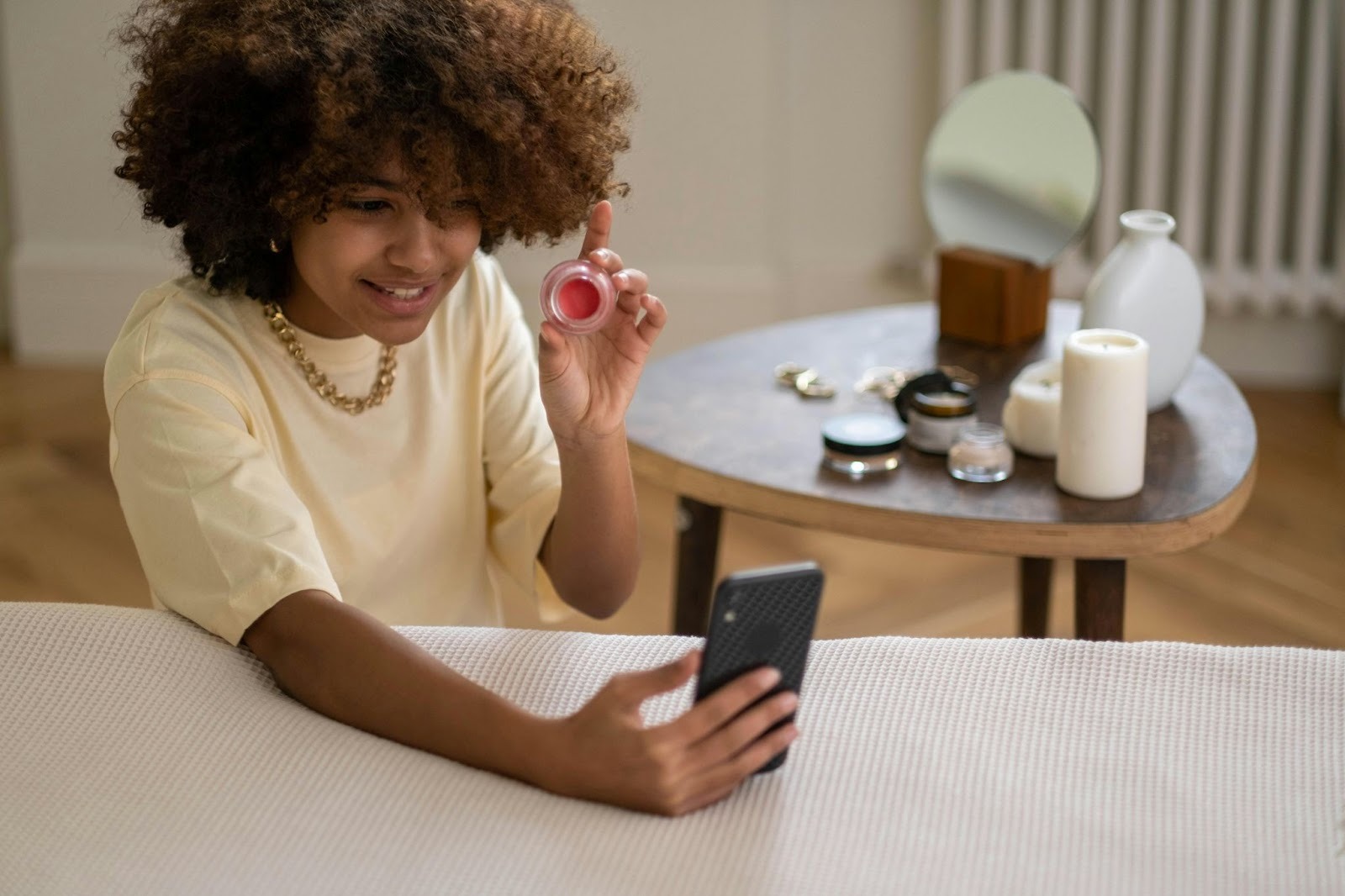
Modification and deletion rules clarify what changes you can make and when content can come down. Spell out which edits are always okay, like resizing or adding captions, and which changes require creator approval, like altering the script or adding new claims. Also, define when the creator can delete a post, what notice is required, and what happens if the content is removed while ads are still running. This prevents last-minute takedowns, awkward disputes, and wasted ad spend.
Renewal options set the rules for extending usage rights if the content keeps performing. If you wait until a video takes off, you are negotiating under pressure and the cost tends to rise. Instead, agree up front on the renewal window, the notice period, and how pricing will be handled, even if it is a simple rate schedule. If a right changes where content runs, how it runs, or how long it lives, it needs to be written.
Once you know which rights you need, the next step is avoiding a few common traps that create disputes.

Most blowups come from details no one wrote down. Here are a few watch-outs you should know.
Whitelisting can perform well, but audiences assume the creator stands behind what appears under their handle. Brands and creators need clear rules on claims, tone, and approvals.
Unpublished ads do not show on profiles, but they are still ads. If your agreement only mentions posts, it may not cover them at all.
Music permissions and platform audio rights do not always transfer to paid ads or owned channels. Edits can also change how content is treated. If edits are part of reuse, they should be allowed explicitly.
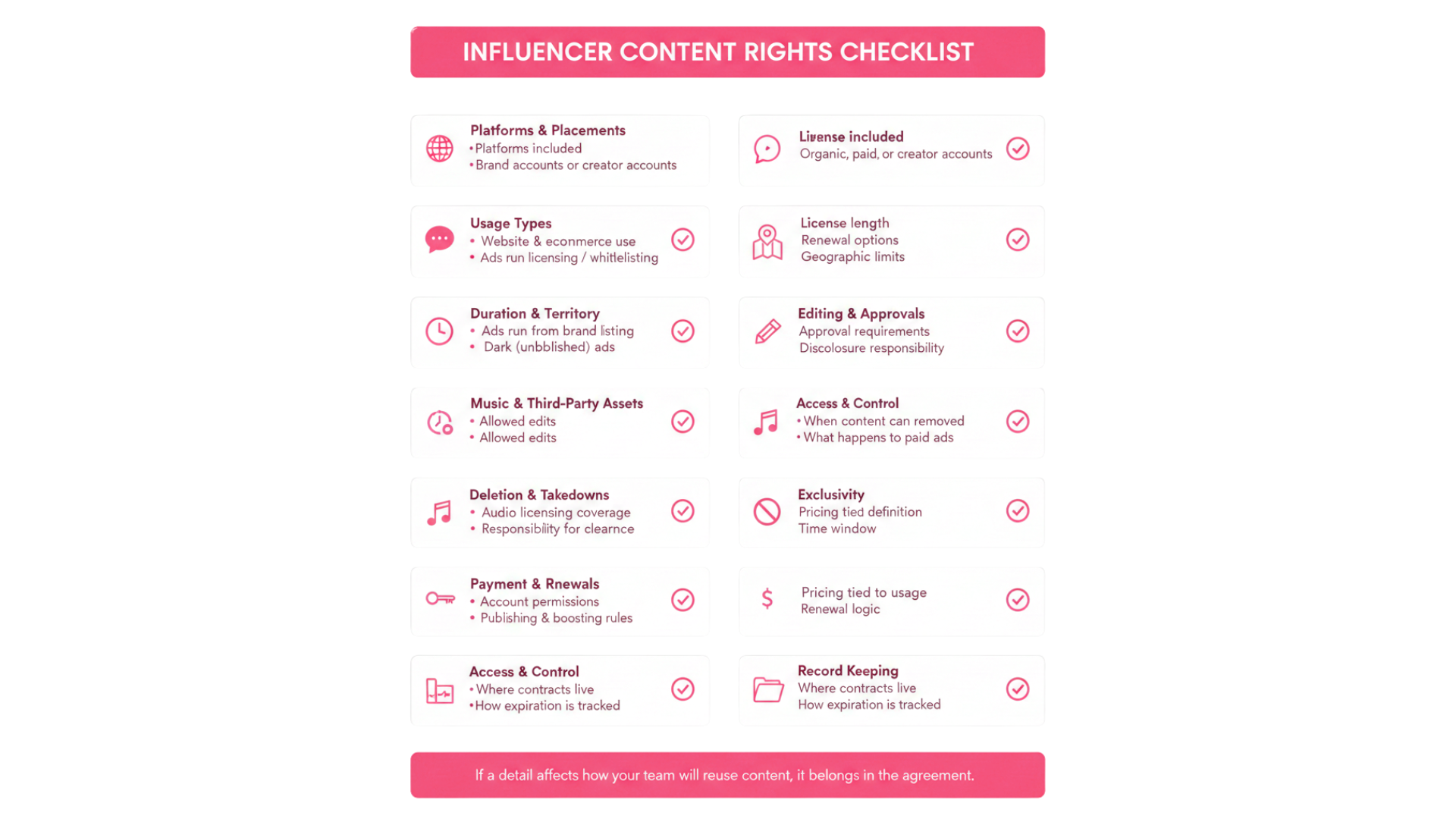
Use this checklist to make sure reuse doesn’t turn into a scramble later. Remember, you don’t need to ask for everything. Make sure the contract matches how you plan to use the content.
Platforms and Placements
Usage Types
Duration and Territory
Editing and Approvals
Music and Third-Party Assets
Deletion and Takedowns
Access and Control
Exclusivity
Payment and Renewals
Record Keeping
If an item affects how your team will reuse content, it belongs in the agreement.
The simplest deals separate two costs:
Start with the baseline deliverables, then add the reuse you actually need. Common add-ons include:
If you are not sure how long you will reuse the content, avoid asking for unlimited rights upfront. A 6 or 12-month license with a clear renewal option usually protects both sides. Renewals go smoother when the rules are set in advance, not negotiated after a video takes off.
Most rights issues happen because no one can answer a simple question quickly.
Track rights as structured fields, not just PDFs. Tie rights to individual assets, not just creators. Set expiration reminders. Add a reuse check before paid launches. Keep a simple record of what was approved and when.
If you run a lot of creator content, Influencity helps you track permissions and expiration dates in one place so teams don’t guess.
Who owns influencer content after a campaign?
Usually the creator. Brands receive licenses unless ownership is explicitly granted.
Can I use content in paid ads if I paid for the post?
Not automatically. Paid usage needs to be granted.
What is whitelisting?
Running ads through the creator’s handle instead of the brand’s.
What if a creator deletes the post?
Write removal rules into the agreement if reuse matters.
Should I ask for perpetual rights?
Only if you have a real long-term plan.
Influencer content rights determine whether content becomes reusable growth assets or one-time posts you cannot touch again. If you take one step from this article, make it this: write the usage plan into the agreement before launch, then track rights like you track deliverables. That is how you protect ROI and creator trust simultaneously.







%20and%20How%20Can%20They%20Benefit%20Your%20Brand%20article.jpg?length=628&name=What%20Are%20Key%20Opinion%20Leaders%20(KOL)%20and%20How%20Can%20They%20Benefit%20Your%20Brand%20article.jpg)




.png?length=628&name=Pop-up%20image%201200%C3%97800@1x%20(1).png)