


Ever had one of those campaigns that technically went “viral” but failed to deliver more than just a few sales? You got thousands of impressions, but they didn’t really turn into anything more, either because you weren’t reaching an interested audience or because you weren’t reaching enough.
For many marketers, the latter scenario is all too familiar. They look at the numbers and immediately get distracted by the number of impressions, only to later realize that this metric alone isn’t enough to define campaign success.
What they needed to look at all along was the campaign’s reach.
So what’s the difference between impressions vs. reach? And which one matters more? In this post, I break down the differences between these two social media metrics. I also provide a few actionable tips on how to improve reach for your campaigns.
Understanding the difference between reach and impressions starts with understanding the definitions for these two terms. Let’s look at the basic definitions.
Reach refers to the number of unique users who see a piece of content. It counts each user once, no matter how many times they view it. It’s essentially the total number of unique views on the content, which makes it an effective measure of audience size.
Impressions are the total number of times a piece of content appears in front of users. It counts all the views, even if the same user sees it more than once. This metric focuses on the frequency of exposure.
.png?width=1716&height=860&name=Tables%20(2).png)
My friends and I regularly spam each other’s Instagram DMs with memes and Reels. Sometimes, they’ll send me Reels that I’ve already seen (and liked).
I even have folks who keep sending me the same clip from the Key and Peele “Substitute Teacher” episode, where Mr. Garvey reads out Jacqueline’s name as “Jay Quelin,” whenever it resurfaces in their feeds. (And honestly, as much as I enjoy the joke, I’m tired of seeing the clip because I’ve seen it at least 20 times.)
So let’s say five of my friends see the clip from the same account in their Explore pages. They all watch it once and decide to send it to me. Two friends mutually know another Jacqueline and send it to her. In this scenario:
You can clearly see how the impressions quickly build up, even though it’s still just seven unique users who ultimately end up seeing the content.
While the above example gives a simple breakdown of how reach works in comparison to impressions, let’s use the dinner party analogy to get an even better understanding of the differences.
Say you’re hosting a dinner party and invite 20 friends. You plan an elaborate meal, but you mostly want to show off the new painting that you just acquired from a renowned artist.
If all 20 friends show up, your reach is 20. It doesn’t matter if Maria stops to look at the painting 3 times or if Lucas walks past it 5 times. Each person is counted only once because reach is a measure of the unique audience.
But impressions measure the gazes or the total views. So every additional view from your guests will count toward the total impressions. In the same scenario, you already get 8 impressions from two people. And if Sofia looks at the painting 3 times, spending a few minutes admiring it each time, you get 3 additional impressions.
So by the end of the night, the painting would’ve garnered hundreds of impressions even if your reach is still just 20.
Now that you have a better understanding of the differences between impressions vs. reach, you’ll also want to know which of these social media metrics matters more. There’s no single right answer to this, as your campaign goal plays a key role in which metric you should focus on.
Reach is generally considered better for measuring brand awareness because it counts unique views. It shows you the number of unique people who saw your campaign. So the more reach your campaign has, the more people you manage to get in front of.
Additionally, reach is an important metric to consider when you want to drive sales from your influencer marketing campaigns. This is because you can typically convert each user only once for a specific campaign. So it doesn’t matter if your campaign drove 10,000 impressions. If your reach remains at 3,000, it means you could potentially convert only 3,000 people (many of whom might not even end up buying).
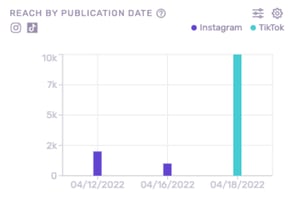
Impressions are typically better for measuring engagement and content effectiveness because they account for the frequency of exposure. It shows you the total number of times the campaign was displayed in front of audiences, so it could account for repeat views.
A post with high impressions could indicate that people came across it multiple times, whether it’s through their feeds, content recommendations, or private messages. It could also indicate that some users are viewing it more than once, which speaks to the value of the content.
So you know what gets people’s attention and understand your campaign’s impact.
You can also use impressions to track which pieces of content manage to get the most eyeballs. This will help you craft future campaigns that achieve virality.
While you ideally want to reach as many people as possible, tracking your impressions is also important to see how the content is delivered across different discovery channels. A targeted reach is great for driving conversions and sales. But high impressions help you gain virality as users come across your content multiple times.
The best thing you can do is keep tracking your reach without ignoring impressions.
Use them both to get a solid understanding of how your campaign is reaching people and engaging them.
When working with multiple influencers, many marketers struggle with campaigns that get plenty of impressions but not enough reach. Most of the time, this doesn’t have anything to do with the quality of influencers or the content itself, but with the influencer mix, where influencers have a significant overlapping audience.
Your influencer mix may seem diverse enough because you’re expanding across several niches, and you’re working with dozens of influencers having a combined reach of over 1 million. So you should be able to reach about a million people easily, right? Not always.
Say you’re working with 15 micro-influencers, each with about 15,000 to 20,000 followers. These influencers have different niche focuses, including DIY crafting, sustainable fashion, home décor, and lifestyle. With these surface-level insights, you might estimate that your campaign should be able to reach at least 2 million people on the lower end.
But what you don’t realize is that most of your influencers share the same followers. So out of those 15,000-20,000 followers, about 5,000 are the same across five different influencer profiles, and another 5,000 are the same across six other influencer profiles.
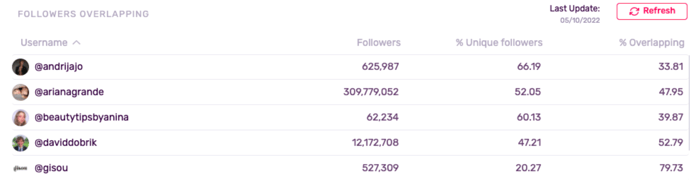
With each audience overlap, your reach declines further. And you end up with a campaign where influencers share 60% of the audience. That means your reach drastically drops below the 2-million estimate.
The result is a campaign that sees plenty of impressions but fails to reach enough unique audiences.
Those 15 influencers may be creating high-quality content for your campaign. But with a 60% audience overlap, the same people may be coming across your campaign multiple times through different influencer content. They may engage and decide to buy, but they’ll typically only buy once.
The worst part is that you’re still paying these influencers in full, with the assumption that you’re reaching over 2 million people. So you’re essentially paying to reach duplicate audiences. This negatively reflects on your influencer marketing ROI.
Now that you know how overlapping audiences can affect campaign reach, the next step is to figure out how to avoid this. How do you truly diversify your influencer mix to reach more people?
The key is to work with multiple influencers who each have a unique audience.
But this gets challenging because you can’t manually compare the followers list across every influencer you want to work with. And most influencer marketing platforms will only account for the total follower count across influencer profiles to estimate your campaign reach. In other words, they won’t account for duplicate audiences.
That’s where Influencity comes in, with powerful analytics tools to accurately account for the unique and shared followers between influencers.
You can add influencers to a list and have the tool analyze their followers. The dashboard will then show you the percentage of unique followers and the percentage of overlapping followers. So you’ll be able to see:
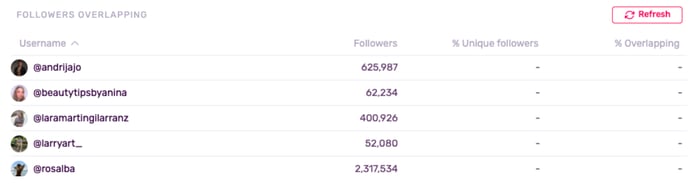
A low overlap indicates that their audience is unique to them, which means you get to reach a fresh new audience with each influencer. So if your goal is to maximize reach, you want to focus on influencers with a low follower overlap.
You can further strengthen your influencer mix with Influencity’s campaign estimation tool. This allows you to add influencers to a list and estimate the outcome of your campaign based on their follower count, tasks, rates, and earned media. You’ll be able to add or remove influencers from an estimate to test different variations and see which mix gets you the best results.
So instead of just blindly experimenting with different influencers, you can make a more informed decision based on the forecasted results. That way, you get to work with influencers who can help you get the most reach.
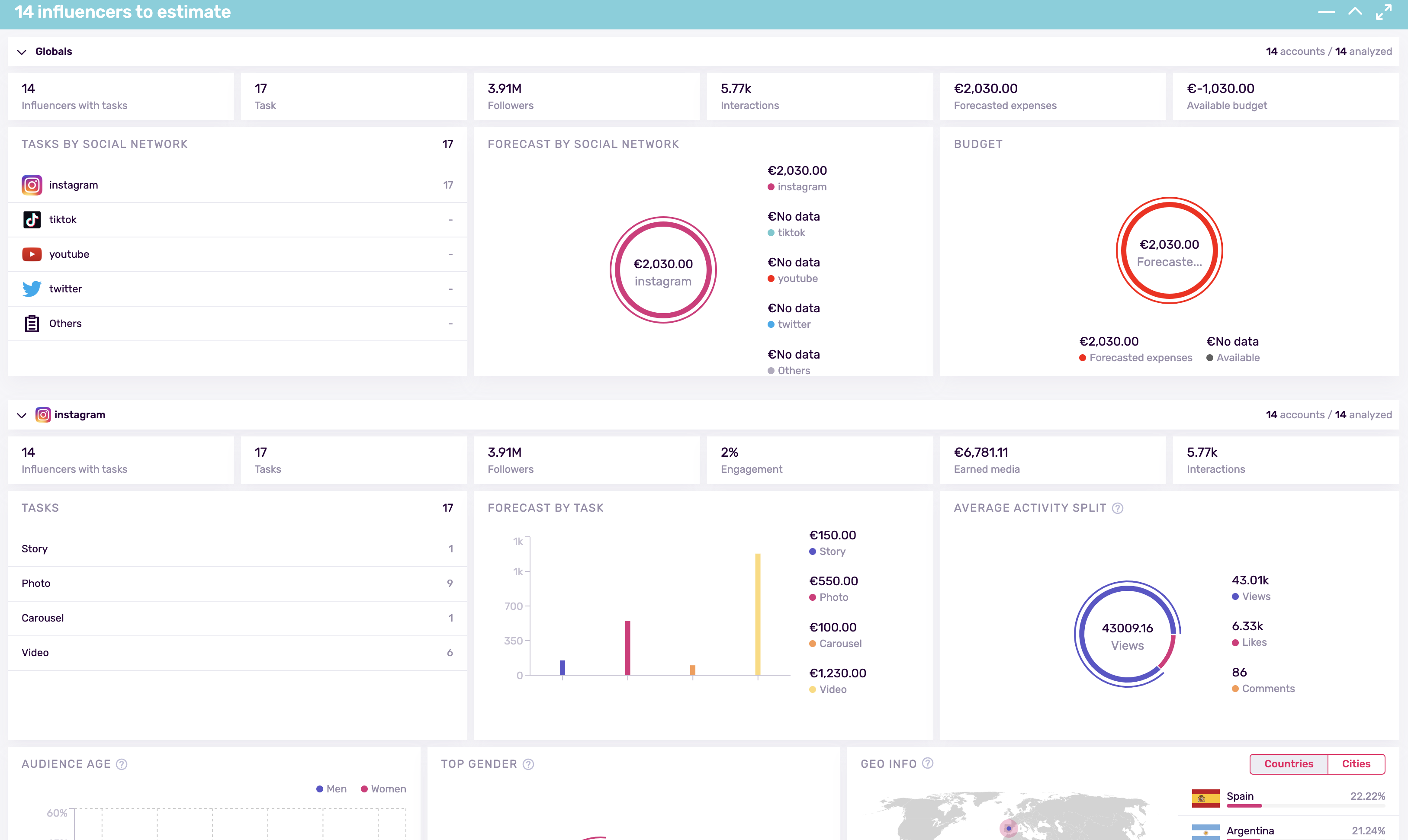
Your influencer marketing reach is a key factor that influences campaign success. This social media metric shows you how many unique people your campaign managed to reach across different influencer profiles.
But multi-influencer campaigns often struggle with audience overlaps, which negatively affects total reach. Influencity helps you “de-duplicate” your audience with a powerful analytics tool to show you the percentage of audience overlap between different influencers. So you can find the right influencer mix and work with creators who can help you reach as many people as possible.
Sign up for a free trial to see how it works.
Reach is generally considered better than impressions, especially for brand awareness campaigns, because it accounts for the unique audience who saw the content. At the same time, impressions still matter because they represent the total number of times the content appeared in front of the audience. This metric can be used to measure content effectiveness and engagement.
Accounts reached refer to the total number of unique accounts that saw the post. Impressions, on the other hand, refer to the total number of views, including repeat views from the same account.
A higher reach to impressions ratio is always desirable because you want your content to reach as many people as possible. Anything above 0.2 can be considered a good reach to impressions ratio.
Impressions can never be less than reach because the metric accounts for the number of times the content is displayed to users. This means it accounts for repeat views while reach only counts each user once no matter how many times they view the content.











%20and%20How%20Can%20They%20Benefit%20Your%20Brand%20article.jpg?length=628&name=What%20Are%20Key%20Opinion%20Leaders%20(KOL)%20and%20How%20Can%20They%20Benefit%20Your%20Brand%20article.jpg)





.png?length=628&name=Pop-up%20image%201200%C3%97800@1x%20(1).png)