


In influencer marketing, engagement data is usually the first thing teams check. Likes, shares, and watch time can make it look like a post is working.
But I see the same thing happen all the time: the numbers look fine, a concern keeps showing up in the comments, and nobody is sure what to change while the campaign is still running. Engagement data alone doesn’t tell you whether people are excited, skeptical, confused, or comparison shopping. It only tells you they reacted.
That’s why teams pair engagement data with social listening for influencer marketing. You can see what people keep saying, what questions repeat across creators, and what concerns are starting to spread.
In this post, I’ll break down how to use engagement data and social listening together so you know what to change while the campaign is still live. You’ll learn what to watch before, during, and after an influencer campaign, and how brands like Rare Beauty use these inputs as part of influencer campaign analytics, not just a recap.
In influencer marketing, engagement data is how people interact with creator content. That includes likes, comments, saves, shares, and watch time.
Engagement data gives you a quick read on how people are responding. It helps you spot which posts got traction, but not what people are worried about or what they want next. And it doesn’t tell you what to change in your brief, your messaging, or your spend.
Social listening helps because it lets you read the comments at scale. You start to see the patterns, not just the loudest opinions. That’s also where UGC engagement sentiment becomes clear. You can tell whether the reaction is mostly excitement, hesitation, confusion, or pushback.
Not every engagement metric tells you what to do next. Likes can mean attention. Saves and detailed questions can mean buying intent. Confusion in the comments means the message needs work. When the campaign is live, each one requires a different move.
Below are the engagement signals teams look at most often, what they are good for, and what they can hide if you do not also read the conversation.
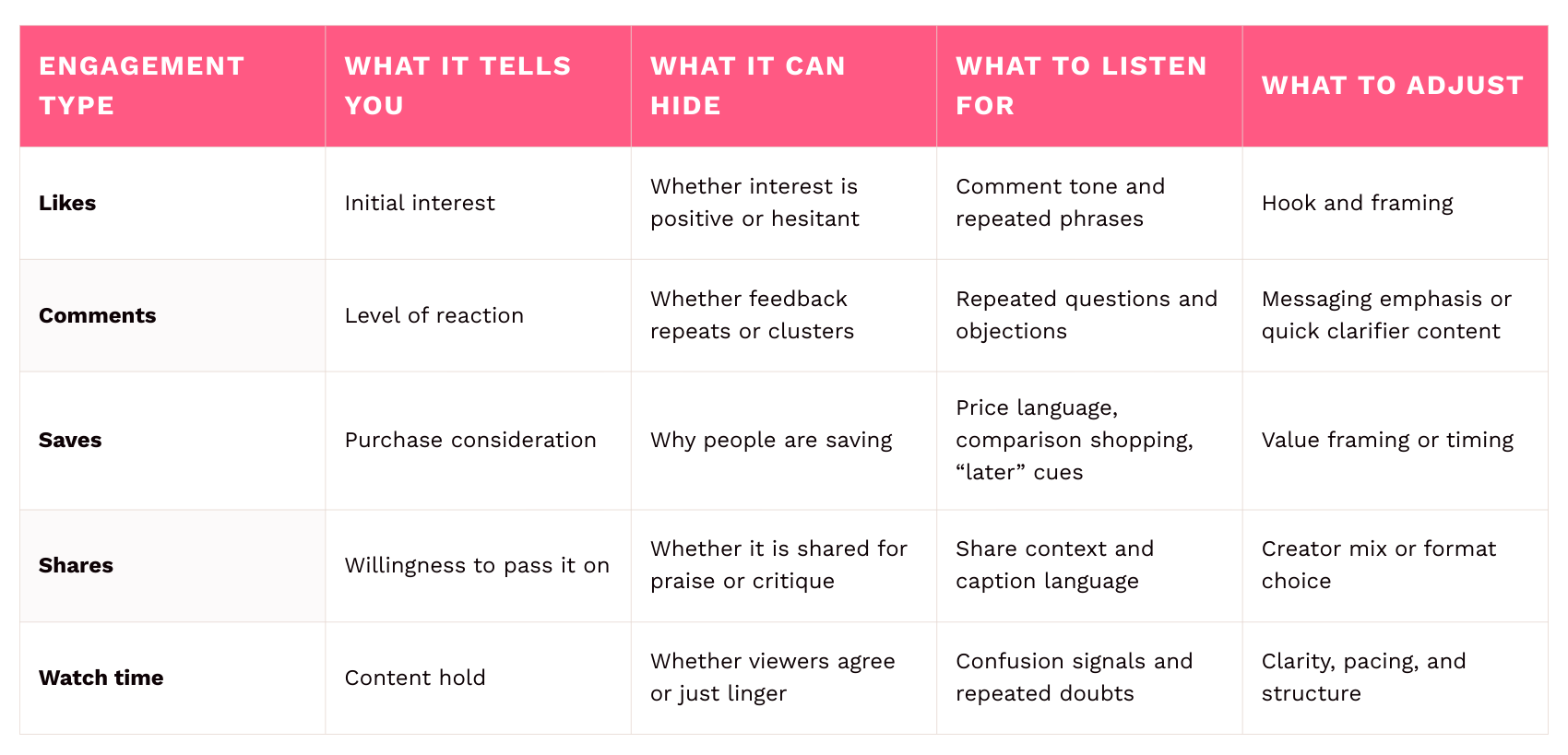
On their own, these metrics answer basic questions about reach and reaction. They do not explain what people mean. A spike in comments can be excitement, confusion, or pushback. A high save rate can be genuine interest or hesitation.
Social listening helps you understand why a metric moved. You can see which concerns keep coming up, what benefits people repeat in their own words, and what’s slowing the campaign down. That’s the difference between reporting performance and improving it.
Social listening is most useful when you tie it to points where you can still make changes. If you wait until the recap, you’re just explaining what happened.
The goal here is to walk into launch with fewer surprises.
What to monitor
What to do with it
This is when confusion can spread fast if the message is not clear.
What to monitor
What to do with it
Steady engagement can hide fatigue. Comments tell you when the campaign is starting to wear out.
What to monitor
What to do with it
This is where social listening becomes a planning tool.
What to monitor
What to do with it
Once you can see both reaction and conversation, you can make changes that protect performance while a campaign is still running. UGC engagement sentiment helps you tell whether reactions are excitement, hesitation, confusion, or pushback, without guessing from a handful of comments.
The key is to treat repeated comment themes as a signal.
What it usually means
People are interested, but deciding whether the value is there.
What to change
What it usually means
Fit and representation are central to the decision.
What to change
What it usually means
Interest is there, but the message is not landing clearly.
What to change

What it usually means
People are comparison shopping in the category.
What to change
What it usually means
The campaign may be overexposed, or the message is attracting the wrong audience.
What to change
Both Rare Beauty and Fenty Beauty can pull strong engagement. The difference shows up when you read the comments. One campaign can drive “this is for me” language and confident buying questions. Another can drive lots of reactions but very little meaning behind them.
Here’s the practical takeaway: two posts can look equally strong in engagement data, but require completely different next moves. Social listening helps you decide whether to protect what is working, clarify what is confusing, or add proof for people who are still deciding.
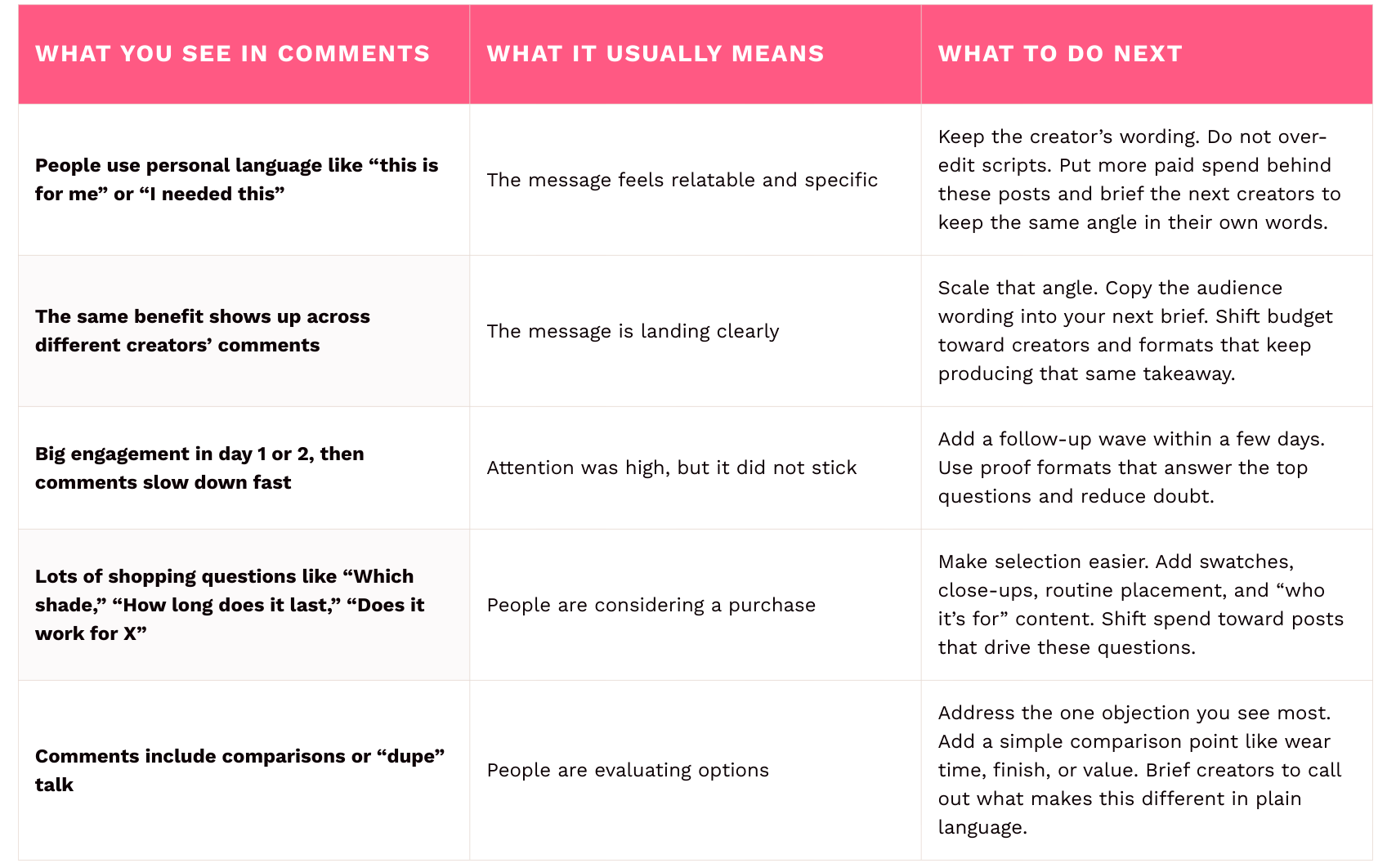
Here’s what “protect” looks like in practice:
Quick spikes means: views and likes jump early (often in the first 24 to 48 hours), then drop off quickly.
Short reactions means comments like: “love,” “need,” “obsessed,” emojis, or one-word replies, with few real questions.
That combo usually means the content grabbed attention, but people still do not understand value, fit, or why it matters.
Proof formats are the fixes that reduce doubt, for example:
Instead of treating the campaign as one big bucket, you compare comment tone by creator:
That tells you exactly where to shift the budget and what to change in the next brief. It also keeps you from scaling a post just because engagement is high.
If you only listen for brand mentions, you miss signals that shape performance before your brand is even named. In influencer marketing 2026, the teams that win are the ones who can read category expectations and audience concerns early, not just report on them later.
Pay attention to
In practice, brand sentiment analysis is less about a single score and more about repeated language and tone. The most useful question is simple: are people moving toward interest and intent, or cycling through doubt and objections.
The point is not a longer report. It is faster learning and clearer decisions next time.
Write down the phrases that show up across creators and platforms. Do not rewrite them in brand language.
Two creators can drive similar engagement and produce very different comment sections. Track who drove intent questions and who drew repeated objections.
Avoid “improve messaging.” Write specific decisions you would make next time:
These decisions become part of your influencer campaign analytics, because they explain what changed and why, not just what performed.
Do not bury it in a recap deck. Add a one-page addendum creators and planners will actually use.
Engagement data tells you what got a reaction. Social listening tells you what people mean, what they doubt, and what they want next. That understanding is now part of performance work, not an extra step.
Brands that build this loop for every campaign improve faster. They make clearer briefs, choose creators more precisely, and adjust messaging and spend based on real audience signals instead of guesswork.
Engagement data in influencer marketing refers to how audiences interact with creator content. That includes likes, comments, saves, shares, and watch time.
Engagement data shows how much reaction a post generated, but it does not explain what people mean in their comments or whether the reaction is positive, hesitant, or confused. To understand that, teams pair engagement data with social listening and brand sentiment analysis.
Engagement data measures the volume of reactions. Social listening looks at the language inside those reactions.
For example, a post might have high engagement, but social listening can reveal whether comments focus on price concerns, confusion about use, or strong buying intent. Used together, engagement data and social listening give teams both the reaction and the reason behind it.
Brands can use engagement data mid-campaign by separating attention from intent.
If engagement is high but comments show confusion or repeated objections, teams can update briefs, adjust messaging, add proof formats, or shift spend toward creators driving clearer buying questions. Tracking UGC engagement sentiment across creators helps teams decide where to scale and where to refine before the campaign ends.
In influencer marketing 2026, brands are expected to improve campaigns while they are still live, not just report results after they end.
Engagement data matters because it shows where attention and interest are building. But in 2026, engagement data alone is not enough. Teams also rely on social listening and brand sentiment analysis to understand what audiences mean, not just how many reacted.








%20and%20How%20Can%20They%20Benefit%20Your%20Brand%20article.jpg?length=628&name=What%20Are%20Key%20Opinion%20Leaders%20(KOL)%20and%20How%20Can%20They%20Benefit%20Your%20Brand%20article.jpg)






.png?length=628&name=Pop-up%20image%201200%C3%97800@1x%20(1).png)