

If you’re like me, you’ve probably experienced the utter disappointment of having your favorite show cancelled. That’s exactly what happened when Netflix cancelled “Sense8” back in 2017. I joined several passionate fans who banded together to petition the company to revive the show.
And it worked…but only for a two-hour sendoff. Although it couldn’t make up for an entire season, it was something. It was definitely better than the abrupt cancellation and the unsatisfactory cliffhangers that Netflix planned to leave us with.
For a while, it saved Netflix’s brand sentiment from dipping further.
Yet the company continues to drop one well-loved show after another, which, in combination with the controversial fee restructuring, indicates that they’re not really listening to their audience. That means they’re essentially missing a huge opportunity to scale and give their audience what they want.
In this post, I explore some of the biggest brand sentiment tracking opportunities that major brands like Netflix and Starbucks are missing out on. I also share a practical guide on how to apply social listening and brand sentiment in your pre-campaign workflow.
You’d think that the biggest brands, with all their money and resources, would be using social listening to track brand sentiment and listen to what their audience wants. But that’s not always the case. Let’s look at these real-life examples of brand sentiment tracking opportunities that could’ve helped some brands scale faster.
Netflix has a history of alienating niche audiences because they keep pulling the plug on well-loved shows. “Sense8” wasn’t the first and definitely not the last.
“Dead Boy Detectives,” “Mindhunter,” “Teenager Bounty Hunters,” …the list goes on. Variety revealed in 2022 that the company planned on throwing more money on producing and promoting new titles. Yet between these cancellations and the rising subscription fees, Netflix stirred up a huge controversy as outraged fans took to social media to criticize the company’s every move.
As expected of any PR crisis, the company’s stocks took a nosedive and its brand sentiment took a hit. Netflix even lost over 200,000 subscribers in Q1 of 2022.
Most of the social media conversations revolved around the streaming service’s history of raising prices and prematurely cancelling well-received shows. Meanwhile, forum discussions are filled with frustrated users expressing their confusion about the company’s decision to invest in lower-quality shows with no depth.
Netflix could use social listening to track brand sentiment changes revolving around major decisions like pulling shows or changing their pricing structure. This could help them understand how audiences are responding to specific moves, which can then guide their decisions.
This is particularly helpful when deciding whether to reinvest in a new show. Instead of prematurely pulling the plug before the show even has a chance to build a following, they could track brand sentiment related to the show to gauge reception.
Starbucks has been involved in its fair share of controversies. One of the more recent ones involves fan outrage over the company’s summer 2026 menu.
The company announced in April that they’ll be bringing back the famous Unicorn Frappuccino. Great news, right? Except the release would be very exclusive. Think: Coachella-level exclusive. Starbucks posted on Instagram that the drink will finally be back in Coachella, which got a lot of festivalgoers excited but left even more fans justifiably livid.
“The people want the Unicorn Frap at every store not just Coachella,” one user wrote.
And it’s not just the Unicorn Frappuccino. Starbucks fans are vocal about what they want, often urging the company to bring back some discontinued menu item in their comments.
By making the item only available in Coachella, Starbucks is missing out on an opportunity to massively grow their sales. After all, festivalgoers can only have so much Unicorn Frap before the company’s sales ultimately stagnate.
Starbucks could use brand sentiment tracking to monitor customer response to exclusive menu releases. They could combine this with social listening data to understand demand and inform their decisions about which items to bring back and where to bring them back.
In the above scenario, for instance, even if it’s not viable to revive the Unicorn Frap in every store, they could track where the conversations are happening. Based on this data, they could offer limited releases in regions that see the most demand.
There was a time when Glossier was in almost every millennial woman’s makeup bag. The brand revolutionized the concept of skincare and makeup decluttering. They kept their SKUs limited and curated the perfect beauty edit consisting of essentials, which differentiated them from traditional beauty brands.
Glossier basically focused on products the truly deserved to be on our shelves—a value proposition that resonated with audiences and played a key role in their success.
But like all brands that went through a major hype, Glossier wanted to scale. And scaling meant expanding to new categories and retail shelves. Along the way, the brand started losing sight of what originally made them resonate with their target audience.
Between layoffs and formula changes, the brand lost its place as the “beauty industry darling” and started getting caught up in one controversy after the other.
Complaints piled up across social media about the brand’s formulations being not as good as it once was, with everything from the Glossier You to the iconic Balm Dot Com losing their popularity.
As creators and fans alike express their disappointment in the brand’s new formulations, Glossier could use the opportunity to address these concerns. Whether this means going back to their original formulation or if it’s not viable, testing new formulations to more closely resemble the original.
Brand sentiment tracking could help Glossier reveal what audiences truly like (and hate) about the brand and their products.
Even my research alone showed a desire for the brand to go back to “the edit,” which was what originally resonated with the audience. People are basically begging the brand to not fix what’s not broken.
One user who claimed to work for Glossier “during the heydays” explained that the company laid off all its data engineers when they used to have over 100 people. And that says a lot about why the company keeps making one bad decision after the other—they no longer have the data to track brand sentiment or analyze what consumers are saying.
That means they’re going in blindly with “tried and true” strategies that would work for most growing beauty brands. But Glossier became Glossier because it wasn’t like any other beauty brand. By failing to inform their decisions with data, the brand ended up becoming like everyone else.
As you can see from the above examples, brand sentiment tracking could reveal valuable insights to inform the strategies of major brands. Similarly, you could use it across various aspects of your influencer marketing campaigns. Here’s how brand sentiment can fit into your pre-campaign workflow.
Tracking brand sentiment around various forms of digital content and paid media could help you figure out what concepts seem to resonate with audiences. Are they intrigued by creativity? Or are they looking for something more heartfelt and authentic?
You could use these insights to come up with stronger campaign concepts that align with what your audience wants.
For example, say you find that a recent competitor campaign that told authentic customer stories saw significant positive brand sentiment. This could indicate that the audience loves authentic storytelling. So you could pitch a creator campaign that focuses on micro- and nano-influencers telling real and relatable stories.
An audience overlap report is a great way to narrow down creators who can help you reach a unique audience. A sentiment analysis further deepens the insights to show you creators who consistently command a positive response for their content.
This is a great way to identify creators who are “brand safe” and are capable of garnering positive brand sentiment.
Platforms like Influencity let you analyze the comments sentiment in influencers’ social media posts. So you can identify creators who consistently receive positive comments over the years.
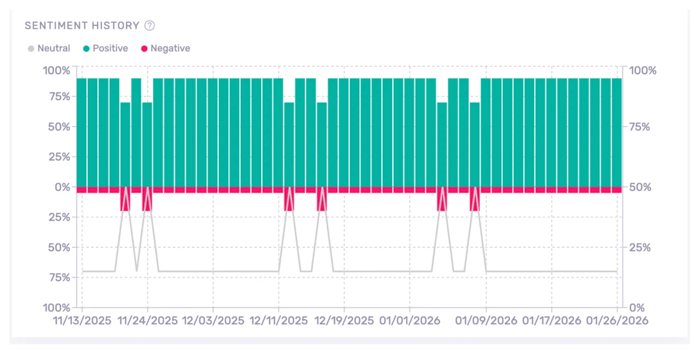
You could even analyze their digital content for other brand safety metrics. What’s the top sentiment they express in their posts? You’ll ideally want to work with creators who create positive content that aligns with your brand’s values. Do they often create content that includes hate speech, offensive languages, sensitive topics, etc.
Influenctity also provides in-depth sentiment analysis that breaks down the emotions expressed by various audiences around a specific topic. So you could see whether your target demographic feels a certain emotion when discussing a creator.
Social listening and brand sentiment tracking can inform various aspects of your influencer briefing process.
With social listening, you can figure out what audiences are discussing and what languages they’re using to discuss it. You can then brief influencers to focus on related topics or use certain languages to resonate with the audience.
For example, if you notice that audiences are talking about barrier repair for sensitive skin, you could get influencers to focus on this angle in their content.
Similarly, a sentiment analysis around a certain topic could help you gauge audience mood. And you can take it into consideration to build more effective briefs.
This could mean advising creators to avoid mentioning X topic because the mood around it is currently negative, so discussing it could be too risky, for instance. Or it could mean encouraging them to be honest about their mental health struggles because people are responding positively to similar content.
For example, say there’s a lot of negative sentiment around your brand’s new product. As you dig deeper into the conversation, you notice that people are mainly criticizing the price point.
In this case, you could brief creators to focus on the product’s value vs. cost, which would mean highlighting how the product is worth the high price because of X and Y reasons.
With brand sentiment analysis showing you how audiences are responding to specific topics, you can effectively identify possible backlash areas before your campaign goes live.
You can use it to analyze a related topic or conversations about your brand as a whole and see whether the responses are positive vs. negative. Social listening will help you dig deeper into the conversations to understand the context behind those sentiments.
For example, your analysis shows that there’s negative sentiment around an upcoming line of products. So you dig deeper into the conversations and find that people are expressing concerns over the possible lack of shade options despite the “inclusive” labeling.
In this scenario, simply positioning the line as “inclusive” could cause more backlash. Instead, you’ll want to demonstrate the actual inclusivity with diverse creators testing how the different shades look on their skin tone.
Your brand sentiment analysis is no longer just for reporting slides. And neither does it belong to just your post-campaign workflow.
Instead, it could reveal valuable insights to inform your campaign during the conception and planning stages. Make the most of the tips and opportunities I shared above to incorporate sentiment analysis and social listening into content direction.
Brand sentiment refers to the feelings inspired by your brand through its content, strategies, and campaigns. For instance, you may get positive brand sentiment after a heartfelt advertising campaign that resonates with audiences.
Influencity is the best tool for monitoring brand sentiment, as it breaks down the emotions behind the sentiment. It goes beyond surface level sentiment metrics and shows you whether audiences are feeling fear, anticipation, joy, hate, disgust, love, and more.
Sentiment analysis shows you how brand sentiment changes after an influencer campaign. This can reveal ho audiences are responding to the campaign.
You can use sentiment analysis to understand how audiences feel about specific influencers, topics, and campaign concepts. This can then inform various aspects of your planning, such as which creators to work with and which campaign angles to focus on.







%20and%20How%20Can%20They%20Benefit%20Your%20Brand%20article.jpg?length=628&name=What%20Are%20Key%20Opinion%20Leaders%20(KOL)%20and%20How%20Can%20They%20Benefit%20Your%20Brand%20article.jpg)




.png?length=628&name=Pop-up%20image%201200%C3%97800@1x%20(1).png)