

Brands are buying user-generated content (UGC) at scale because it performs. UGC converts for the same reason it feels authentic, it doesn't look like an ad. If you’ve ever struggled to set a fair UGC price, you’re not alone.
This shift has created a new kind of creator, the content-first specialist. A traditional influencer is paid for access to their audience. A content-first specialist is paid to create content the brand can run on its own channels and in its ads. Their follower count is optional. Their value is in the ideas, scripting, on-camera work, and editing that turn a product into a believable story.
These creators don't need millions of followers to get paid. Their value lies in their creative skill, not their reach.
But that’s where the challenge comes in for agencies and marketers: How do you price a creator’s skill, not their following?
UGC pricing is still the wild west of influencer marketing. You’ll find everything from a $150 TikTok video to a $5,000 content package. Both can be fair, but the UGC price depends on the brand’s goals, the content's complexity, and, most importantly, the usage rights.
I’m about to break down how to price UGC like an expert, find a balance between creator fairness and measurable ROI, and build compensation models that reflect the value of creative work today.
UGC is driving real performance. For many brands, up to 50% of their top-performing ad creatives are now UGC. This is a change in how people respond to advertising.
UGC converts better because it feels authentic and trustworthy, not overly produced. Consumers are tired of glossy, highly-staged ads. They respond to genuine product experiences shared by someone who seems like them.
Agencies have caught on. They are quickly building dedicated "UGC rosters" alongside their traditional influencer networks. They see the opportunity in having a bench of skilled creators ready to deliver authentic ad creatives on demand.
Pricing UGC is completely different from pricing a traditional influencer collaboration. You have to change your focus.
It’s ALL about creative quality and usage rights.
When you hire a content-first creator, you are buying a content asset, not distribution to an audience. The creator’s follower count is basically irrelevant to the transaction. What matters is the quality of the video, the storytelling, and the final deliverable.
Several factors push the price up or down:
Since there’s no single price standard, marketers are using a few core models to structure their deals.
This is the simplest approach: a fixed, flat rate for each final piece of content (one video, one set of photos, etc.).
The creator delivers a bundle of content assets designed to work together, often with a consistent look or narrative. For example, three different video hooks for the same product, or one long-form video and five vertical cut-downs.
This is essential for any brand running paid ads. It breaks the compensation into two parts:
Why it works: It’s fair to the creator because they are compensated for the commercial value their content generates through your ads. It protects the brand by ensuring you have the legal right to scale the content.
For brands with continuous content needs, a retainer is often the most cost-effective solution.
Best for: Ongoing organic social content, continuous ad testing, or brands that want to maintain a consistent creative partner. The price per asset generally drops significantly in a retainer model.
Agencies are uniquely positioned to standardize the UGC process and turn it into a scalable engine for performance.
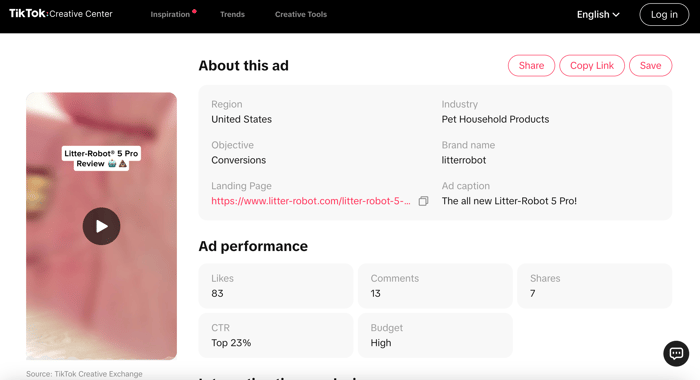
To get the most value out of UGC and build strong creator relationships, focus on these actionable steps.
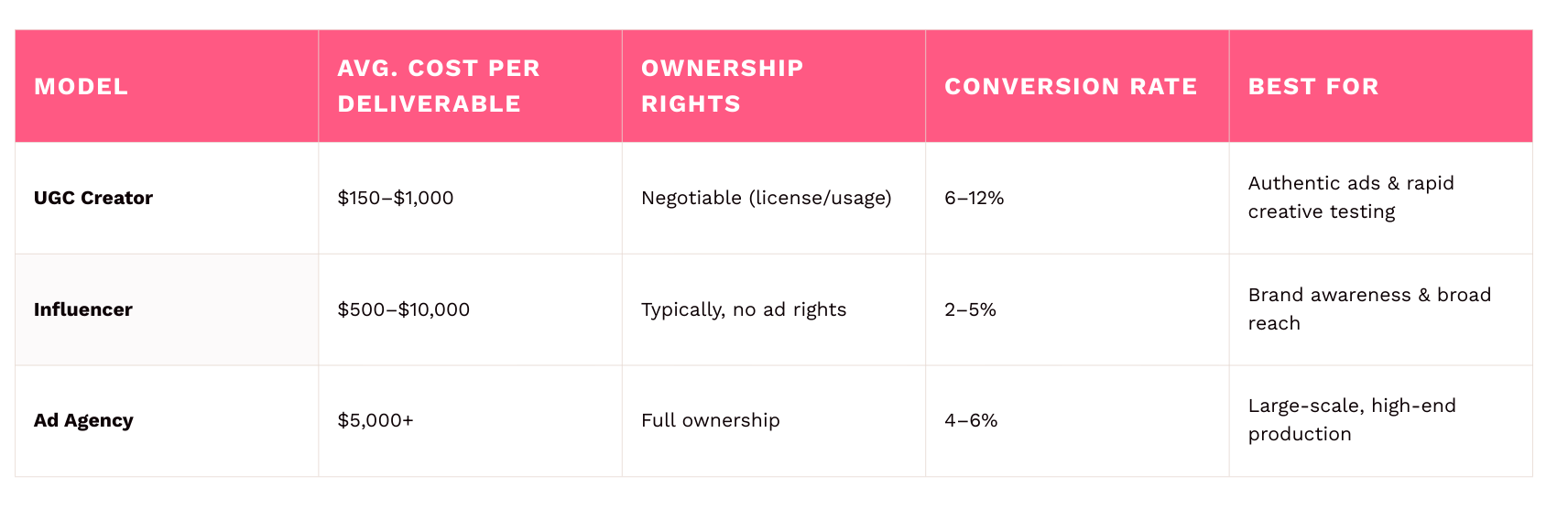
UGC offers a powerful middle ground. It delivers high authenticity and quick scalability at a fraction of the cost associated with traditional production or macro-influencer deals.
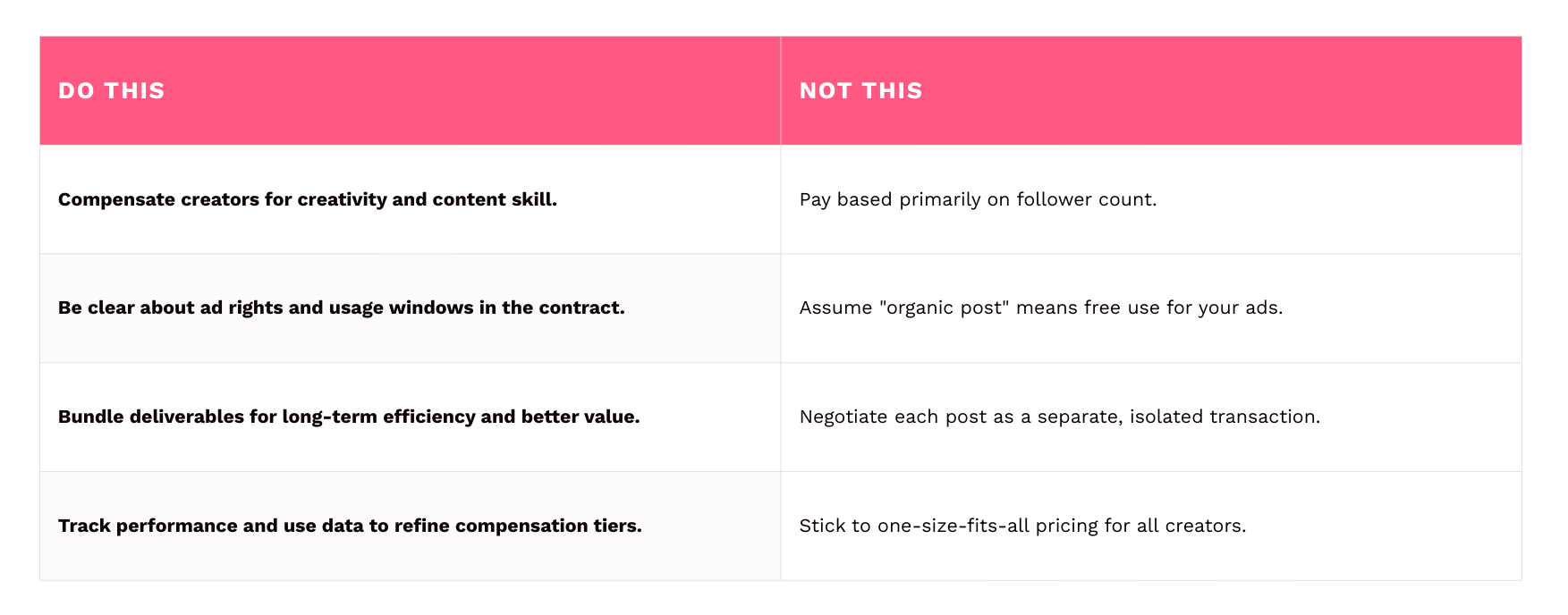
The new frontier of creator compensation is here, and it's centered on content value, not audience size. UGC pricing is evolving fast, but the smart money is on models that separate the creation fee from the commercial usage fee. A clear UGC price framework helps you do that consistently.
By using tiered UGC pricing, negotiating usage rights upfront, and leveraging content tracking tools, agencies and brands can build UGC programs that are fair to creators and deliver massive ROI. You're not just buying a video; you're buying a high-performing creative asset. Price it that way.
Ready to scale your UGC program and accurately track the performance of every single creative asset?












%20and%20How%20Can%20They%20Benefit%20Your%20Brand%20article.jpg?length=628&name=What%20Are%20Key%20Opinion%20Leaders%20(KOL)%20and%20How%20Can%20They%20Benefit%20Your%20Brand%20article.jpg)