


When you launch an influencer marketing campaign, it’s essential that you regularly monitor a series of key metrics to ensure that your campaign is hitting your objectives and generating a good return on your investment. One of these key metrics is Cost Per Mille, also known as CPM for influencer marketing. CPM is one of the clearest ways to understand how much you are paying for visibility, which is why it remains such an important metric for brands running awareness-focused creator campaigns.
In today’s article, we will break down the concept of Cost Per Mille (CPM) in influencer marketing and explain how you calculate this important KPI. We will also look at how CPM works in practice, what it can and cannot tell you about campaign performance, and how to interpret it alongside other metrics like reach, engagement, clicks, and conversions. We will also share valuable insights to help you determine the optimal CPM for your influencer marketing campaigns. Rather than treating CPM as a fixed benchmark, the goal is to help you understand how to evaluate it in context so you can make better decisions when comparing creators, planning budgets, and measuring results.

Cost Per Mille (CPM), derived from the Latin word for one thousand (mille), is a metric used in the advertising and marketing industry to measure the cost of reaching 1,000 impressions, regardless of whether users interact with your content or not. In simple terms, CPM tells you how much you are paying for visibility. It is one of the most common pricing and planning metrics in digital advertising because it helps marketers estimate how expensive it is to put a message in front of a given audience size.
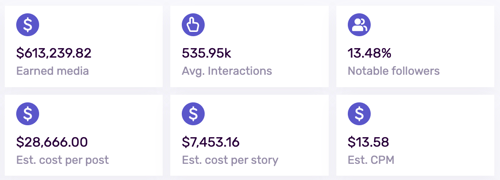
CPM is commonly used in the pricing models of online advertising platforms, including display ads, banner ads, and video ads. It helps advertisers understand the relative cost of reaching a certain audience size so that they can compare it to other advertising options. It is especially useful when the main goal of a campaign is awareness, reach, or brand visibility rather than direct clicks or conversions. CPM is also a common metric for quantifying the influencer marketing investment you need to make to ensure your campaigns are worthwhile. In influencer marketing, CPM can be a helpful way to compare creators or campaign formats, particularly when you want to understand how much visibility a collaboration is likely to generate relative to its cost.
Your CPM for influencer marketing can vary depending on a number of factors, including:
However, it's important to note that CPM is just one of several KPIs advertisers consider when evaluating the effectiveness and efficiency of their advertising campaigns. Other metrics such as click-through rate (CTR), earned media value, conversion rate, return on ad spend (ROAS), and cost per click (CPC) provide additional insights into how well an ad campaign is performing. That is an important distinction, because a low CPM does not automatically mean a campaign performed well. It may mean your content was inexpensive to distribute, but that does not tell you whether the audience cared, clicked, remembered the brand, or converted. For that reason, CPM works best when it is analyzed alongside other metrics rather than in isolation.
.png?width=1685&height=764&name=Tables%20(20).png)
It is also worth keeping one thing clear from the start: CPM measures cost per 1,000 impressions, not cost per 1,000 people reached. Impressions can include repeated views from the same user, which means CPM is useful for understanding media efficiency, but not always for understanding unique audience exposure.
Mi crítica aquí sería esta: el bloque original define bien CPM, pero todavía no deja del todo claro why marketers use it, when it is helpful, and what its limitations are. Ahí es donde más conviene reforzarlo.
To calculate your influencer marketing CPM, you simply need to gather the right data, then use a simple formula to determine your Cost Per Mille for a campaign.
Let’s break this down.
The first thing you need to do is collect all the data you will need for your formula.
This includes:
The best way to collect this data is by using analytical tools provided by social media platforms. Most major social platforms offer native analytics, and influencer marketing platforms can help centralize this data when you are comparing several creators or campaign formats at once. For example, if you or your influencer have an Instagram Creators or Business account, you have access to the platform’s free native analytics tool, Instagram Insights. This tool can help you accurately track and measure the total impressions generated by your influencer's content. Depending on the campaign, it can also be useful to collect reach, engagement, clicks, saves, video views, or conversions at the same time, since CPM on its own does not tell you whether the campaign actually performed well beyond visibility.
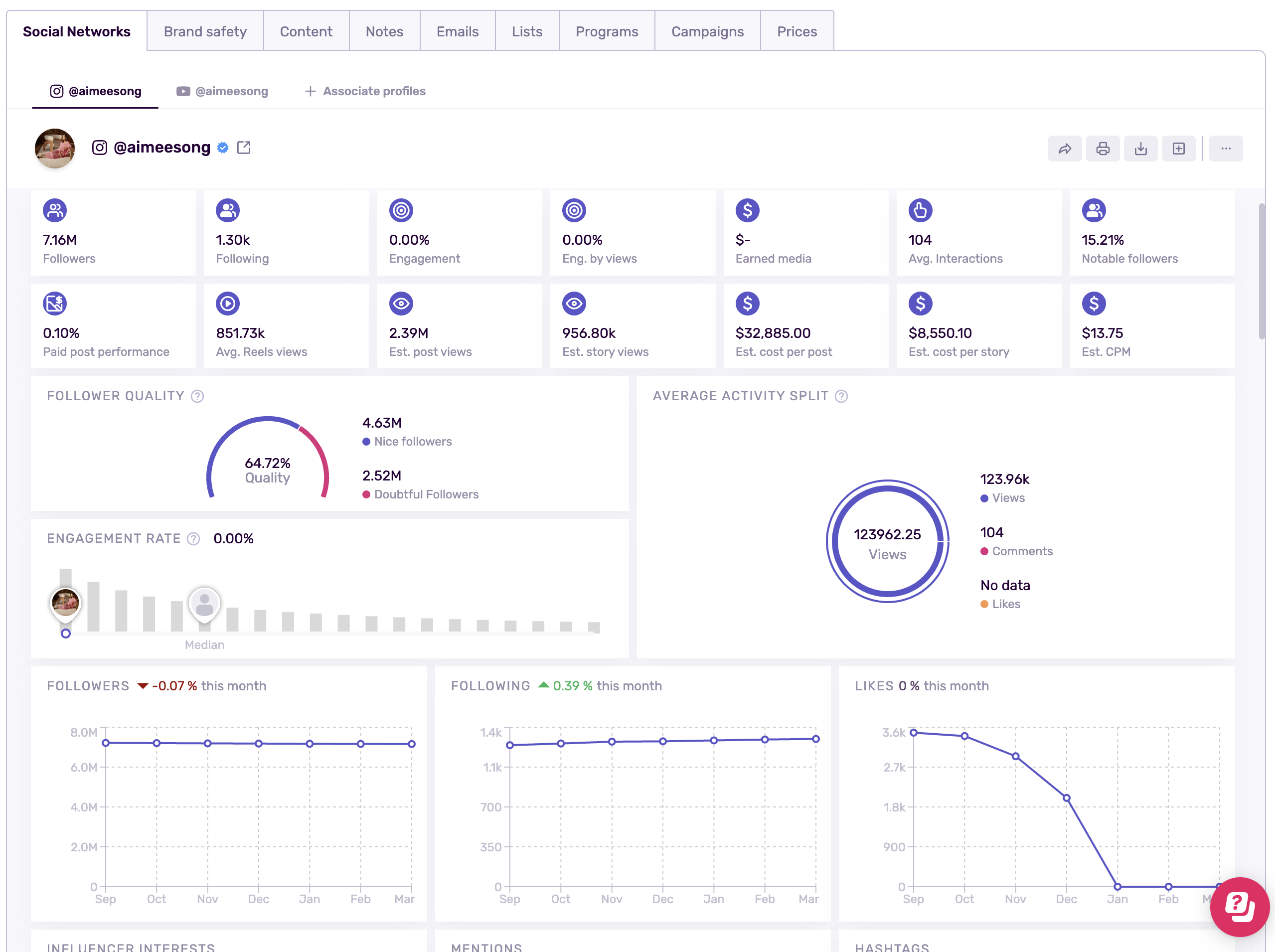
Once you’ve got that information to hand, you’re ready to calculate your CPM.
The formula for calculating your influencer marketing CPM is as follows:
.png?width=450&height=94&name=Resources%20(17).png)
Here's a step-by-step example:
Let's say you paid an influencer $500 to create a sponsored post for your product, and the post generated a total of 100,000 impressions.
In this case, your calculation would be:
.png?width=450&height=95&name=Resources%20(18).png)
Therefore, the CPM for your influencer marketing campaign would be $5.
Remember that CPM is a useful metric for comparing the cost efficiency of different marketing strategies or influencers. A lower CPM indicates that you're getting more impressions per dollar spent. However, CPM alone doesn't provide the full picture of the campaign's success. You should also consider engagement metrics (likes, comments, shares), click-through rates, conversions, and overall campaign goals when evaluating the effectiveness of your influencer marketing efforts. In practice, CPM works best when you analyze it alongside the metrics that match your objective. If your campaign is focused on awareness, you may want to compare CPM with reach, video views, or frequency. If your goal is traffic, CPM should be reviewed together with clicks and CTR. If your goal is sales, then conversions, CPA, and ROAS usually matter much more than CPM on its own.
It is also worth remembering that CPM can vary a lot depending on the creator, platform, content format, audience market, and campaign setup. A higher CPM is not always a bad sign if the audience is highly relevant or the content drives stronger engagement or conversion quality.
So, what is the optimal CPM for influencer marketing? How do you know what you should be aiming for with your campaigns?
In fact, the optimal CPM for your brand will depend on a number of aspects, including the nature of your campaign. Some brands might prioritize brand visibility, making a slightly higher CPM acceptable if it reaches a more relevant audience. However, for campaigns focused on driving conversions, a lower CPM might be preferable, as it implies better efficiency in turning impressions into actions.
Moreover, a higher CPM does not necessarily equate to better performance. While a higher CPM might indicate premium placements or niche targeting, it doesn't guarantee better results. As a result, determining the optimal Cost Per Mille (CPM) involves striking a balance between your campaign objectives, target audience, and available budget. The most useful way to think about CPM is not as a universal target, but as a context-driven metric. A “good” CPM depends on what you are buying, who you are trying to reach, and what kind of outcome matters most. CPM-based pricing is often most useful for awareness-focused campaigns, where the main goal is visibility rather than direct response.
.png?width=1678&height=753&name=Tables%20(21).png)
A brand awareness campaign may tolerate a higher CPM if the creator reaches a very relevant audience and the content delivers strong visibility in the right niche. In that case, the question is not just “Was the CPM low?” but “Was the exposure worth the cost?”
For example, imagine a wellness brand pays $2,000 for a creator campaign that generates 200,000 impressions. That gives a CPM of $10. If the brand’s goal is awareness and the creator’s audience is highly aligned with health-conscious consumers, that CPM could be perfectly reasonable.
Now imagine an e-commerce brand runs a creator campaign with a $15 CPM, which looks acceptable at first glance. But if the content produces very few clicks, weak engagement, and no measurable sales, then the CPM may not have been efficient for a performance-focused campaign.
On the other hand, a niche campaign can have a higher CPM and still be a better investment. A B2B software brand, for instance, might be happy to accept a relatively expensive CPM if the creator reaches a much smaller but highly specialized audience that is actually relevant to the product. In cases like that, relevance often matters more than cheap impressions.

This is also why fixed CPM ranges can be misleading. Category, platform, creator format, and target market all affect pricing. Shopify notes, for example, that beauty content on TikTok may command around $10 to $20 CPM, which shows how much CPM can vary by niche and format rather than following one universal benchmark.
However, it's important to remember that rates will always depend on the type of campaign that you are launching and the size of your target audience. For example, niche-influencers will often have a higher CPM due to their smaller audience size. In this case, it's important to compare your CPM to the actual number of conversions. That way, you will understand the percentage of people who actually act after seeing your campaign.
Ultimately, to determine the optimal CPM for your campaigns, consider your overall objectives, the nature of your product or service, historical campaign data, and industry benchmarks. In addition, regularly monitor Key Performance Indicators (KPIs) beyond CPM, like click-through rates, conversion rates, and return on investment (ROI), to gain a comprehensive understanding of your campaign’s performance. That way, you will have all the data you need to create a successful campaign that will help you reach your goals. If your campaign is awareness-led, compare CPM with reach, frequency, and video views. If it is traffic-led, compare CPM with clicks and CTR. If it is conversion-led, compare CPM with CPA, ROAS, and final sales impact. That is usually the clearest way to judge whether your CPM was actually optimal or just cheap on paper.

CPM means Cost Per Mille and shows how much you pay for 1,000 impressions in a campaign.
To calculate CPM, divide total campaign cost by total impressions and multiply by 1,000.
CPM is important because it helps brands understand the cost of visibility and compare campaign efficiency.
No. A lower CPM can look efficient, but it does not always mean the campaign delivered better results.
You should also look at reach, engagement, clicks, conversions, CPA, and ROAS.
















%20and%20How%20Can%20They%20Benefit%20Your%20Brand%20article.jpg?length=628&name=What%20Are%20Key%20Opinion%20Leaders%20(KOL)%20and%20How%20Can%20They%20Benefit%20Your%20Brand%20article.jpg)