

A guide to influencer marketing tactics for tech teams and influencers. What to film, what to say, how to measure, and how to run seeding with an embargo.

Most people don’t buy a tech product because they saw the features. They buy when they see a fix to a real problem, an easy setup that works on the first try, or a short routine they can copy today (e.g., a 30-second Alexa bedtime routine).
That’s why influencer marketing tactics are highly effective for tech. The right post removes one piece of friction moving someone from “maybe later” to “I can do this.”
In this blog, we examine what it takes to make this happen. Think of influencer marketing tactics as everything you can control in a launch week:
the content formats you publish
the types of creators you choose
the campaign setups you run,
the timing of when posts go live,
the execution of product seeding that lets creators test and film on time
You will see how these ideas show up in content from Google Pixel, Amazon Alexa, and Meta Quest, and how to translate them to your product.
We’ll map common friction points for tech buyers and users, match each one to a simple content format, and close with a product seeding timeline and embargo plan.
First, let's outline the friction points we need to overcome and the specific influencer marketing tactics that address them.
Here are the common friction points that consumers and B2B decision-makers face, and the influencer marketing tactics you can use to remove each one.
|
Friction point |
What the buyer is thinking |
Content type that solves it |
How it looks |
What to measure |
|
Setup fear |
“I will mess this up.” |
First-10-Minutes Setup |
Unbox, plug in, app connect, name device, one working test command |
User comments that say “I did this,” fewer support questions |
|
Ease of use |
“Will this be simple every time?” |
Everyday use micro-demo |
A 30–60 second task in real time, plain narration, no jump cuts |
Completion, saves, “I can do this” comments |
|
Feature doubt |
“Does this feature actually help?” |
Hands-on Demo |
Before clip, on-screen taps, after clip side-by- side |
Demo completion rate, saves |
|
Credibility gap |
“Is this hype or real?” |
Before/After A-B Test and micro-experts first |
One variable changed, clear labels, expert voice |
Watch time through the comparison, comment quality |
|
Time cost |
“I do not have an hour.” |
Use-Case Routine |
A 5 to 10 minute routine tied to a daily moment |
Shares, repeat viewers, search lift on feature terms |
|
Motion or comfort |
“Will this make me queasy?” |
Comfort tip + short session |
Room setup, one comfort setting, single 10-minute activity |
Completion and “this helped” comments |
|
Privacy and security |
“Who sees my data?” |
Live Q&A or office hours |
Settings shown on camera, timestamps for replay |
Live retention, replay minutes |
|
Device fit |
“Will this work in my space or with my gear?” |
Renter-friendly setup |
Small space example, no drilling, clear gear list |
Saves, “does this work with X?” comments |
|
Post-purch. drop off |
“I set it up and never used it again.” |
Three-weeks-later update |
What stayed on, what changed, one surprise benefit |
Return viewers on the three-weeks- later update, saves/comments about continued use, creator-coded or UTM conversions in day 8-28 |
When you study their best creator posts, the pattern is consistent. Pixel makes fixes visible. Alexa makes the set-up session a success. Quest makes a short session feel doable. Use the cards below to borrow these moves for your product.
Google Pixel — Show the fix
Goal: Prove a camera or AI feature solves a common photo problem.
Film: Real “before” in tough light or motion → on-screen taps → clear “after” side by side.
Say: Name the problem, name the feature and step, give one use rule.
Formats that work: Hands-on demo; A/B test (feature off vs on); real-world challenge.
Track: Demo completion, saves. For A/B, retention through the comparison and comment quality.
Avoid: Showing only the result, using only studio light, stacking too many features.
Author note: One problem, one fix, one result.
Amazon Alexa — Make the first 10 minutes succeed
Goal: Reduce setup fear and reach one working routine on day one.
Film: Unbox → plug in → app connect → name device → one working command (“Alexa, turn on Bedroom Lamp”).
Say: Short prompts; one common mistake and fix (rename to a word you will actually say); one next step.
Formats that work: First-10-minutes setup; One mistake to avoid; Live Q&A for recurring questions.
Track: “I did this” comments, fewer setup tickets; for Q&A, live retention and replays.
Avoid: Skipping app screens, no test at the end, long narration.
Meta Quest — Fit into a normal day
Goal: Widen use beyond gamers with short, repeatable sessions.
Film: Room setup → one comfort toggle → single 10-minute activity → quick check-in at the end.
Say: Name the time window, show where to change the comfort setting, name the benefit at the end.
Formats that work: Use-case routine; Comfort tip + short session; Three-weeks-later update.
Track: Completion and repeat views; “this helped” comments; mid-tail conversions in days 8–28.
Avoid: Long sessions, ignoring comfort settings, skipping room setup.
Choose the content type by the friction point you want to remove. Each type below explains what to use it for, what to ask the creator to film and say, and how to check if they are a good fit. Keep your influencer marketing tactics simple: pick one type per post and solve one problem at a time.
Use for: walking through setup, showing privacy settings, and demonstrating features step by step
Brief to the creator: “Show every tap and menu on screen. Include one common mistake and show the fix in the same video.”
How to vet: calm pacing, labels on screen, screen recording and captions; look for comments like “I followed this”
Best for: setup fear, privacy questions, ease-of-use doubts, “does this feature help?”
Use for: making a launch feel real and trustworthy
Brief to the creator: “Show weight, ports, materials, first start-up, then run one simple, fair test buyers care about.”
How to vet: crisp close-ups, correct feature names, fair A/B comparisons with only one thing changed
Best for: feature doubt, credibility gap, device fit
Use for: showing how the product fits into a normal day
Brief to the creator: “Film a 5–10 minute routine tied to a daily moment and end with one plain sentence about how it felt.”
How to vet: real homes or workspaces, repeatable short routines, clear speaking with captions
Best for: time cost, ease of use, post-purchase drop-off

Use for: winning trust with specific audiences like IT admins, photographers, installers, or physical therapists
Brief to the creator: “Do one job task from your world. Put any needed settings or data on screen. Follow safety and claims rules.”
How to vet: visible credentials, thoughtful peer questions in comments, precise language
Best for: credibility gap, B2B adoption, privacy and security
Author note: Pick the friction point first, then the creator type, then brief one format. This keeps edits short and results clear.
Before you ask creators to post, give them time to live with the product. Seeding is simply getting devices into the right hands early and supporting them while they set up, test, and film. The goal is that, when the embargo lifts, your audience sees real setups, short demos, and one or two routines they can copy the same day. The steps below show who to seed first, what to put in the box, and how to keep timing tight so launch day lands cleanly.
In practice, this means three things:
Author note: Plan for rough cuts five to seven days before the embargo. That buffer keeps launch day on track if anything changes.
Embargo lifts on [DAY, MONTH DD, YYYY] at [HH:MM] [TIME ZONE].
Please hold all public posts until this time. Teasers allowed: [Yes/No].
Questions: [email] and [phone].
Tip: Put the embargo card on top in the box and repeat the same details at the top of the brief and in the confirmation email. Consistency prevents last-minute confusion.
|
Stage |
Timing for tech launches |
What happens |
Notes |
|
Selection and outreach |
5 to 6 weeks before launch (adjust based on complexity of product) |
Confirm creators, usage rights, and disclosure plan |
Ask for shipping info and preferred formats |
|
Product shipping |
3 to 4 weeks before launch (adjust based on complexity of product) |
Ship kits so creators can set up and test |
Include quick start, use cases, and the embargo insert |
|
Testing and content prep |
2 to 3 or more weeks in hand |
Creators live with the product and film |
Set an internal content-ready date 5 to 7 days before embargo |
|
Embargo lift |
Launch day or a set hour |
Posts publish in a 24 to 48 hour window |
Keep the timestamp firm; have a backup creator and a fallback format |
|
Post-embargo amplification |
1 to 2 weeks after launch |
Reshare, boost top posts, add email and landing page embeds |
Schedule a three-weeks-later update while product is still in hand |
For these influencer marketing tactics, track three primary KPIs after the embargo window:
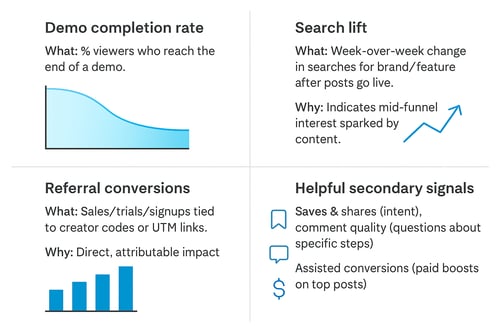
To know whether your influencer marketing tactics worked, focus on three simple KPIs that tie directly to buyer behavior: did people finish the demo, did interest grow, and did anyone take action. Keep the stack light—track these three first, then glance at secondary signals for nuance.
Demo completion rate
What: % of viewers who reach the end of a demo.
Why: Finishing suggests they understood the steps and saw the result.
Track: Note video length → check retention at the final key moment → log in a sheet.
Benchmark: Shorts/Reels 30–50%; YouTube 25–40%.
Search lift
What: Week-over-week change in searches for brand/feature after posts go live.
Why: Indicates mid-funnel interest sparked by content.
Track: Pre-pick 3–5 terms → compare post-embargo week vs. prior week → note % change.
Benchmark: Coordinated embargo should lift at least one term.
Referral conversions
What: Sales/trials/signups tied to creator codes or UTM links.
Why: Direct, attributable impact.
Track: Unique code/UTM per creator → group by wave/format → report total + CPA.
Benchmark: 7–14 day window for consumer; 30–60 for B2B trials.
Helpful secondary signals
Saves & shares (intent), comment quality (questions about specific steps), assisted conversions (paid boosts on top posts).
Use a lead quality field in your sheet. Ask sales to tag creator-sourced leads.
Track time to first value for trials that came from creator posts.
Treat comment quality as a content fit signal for future topics.
Select the top two influencer marketing tactics by completion and search lift.
Fund cutdowns (shorter versions) or paid support for those posts.
Archive formats that did not move to completion or search.
Plan the three-weeks-later update for the winners while the product is still in hand.
Influencer marketing tactics work when you choose the friction to remove, pick the right format, and ship on time. Influencity helps you do the unglamorous parts fast: finding the right creators, keeping briefs and embargoes straight, and measuring what mattered.
Do this in Influencity
Your next move
Pick the friction, pick the format, brief two creators, and log it in Influencity. That’s how influencer marketing tactics in tech turn into launch content people actually use, and results you can report.






%20and%20How%20Can%20They%20Benefit%20Your%20Brand%20article.jpg?length=628&name=What%20Are%20Key%20Opinion%20Leaders%20(KOL)%20and%20How%20Can%20They%20Benefit%20Your%20Brand%20article.jpg)



.png?length=628&name=Pop-up%20image%201200%C3%97800@1x%20(1).png)