


Spend enough time on social media, and you’ll come across influencer content that raves about a product. In most cases, you’ll see influencers clearly disclosing when they’ve been paid by the brand or gifted a product. Sometimes, however, things get a little blurry. You can see that the influencer seems to be promoting the product, but there’s no mention of whether it’s sponsored or not.
Here's a post I found of an influencer who seems to be promoting a Dyson Air Wrap. The video shows her using the product, and the caption mentions how she uses it every two days to get a salon blow-dry effect.
The content looks very promotional, but there’s no mention of a sponsorship (or a lack of one). No #AD or #sponsored, or even a #notsponsored. So there’s no knowing whether this is branded content or completely organic.
The FTC and ASA already have influencer regulations in place that require the disclosure of sponsored content. But even today, influencers don’t always comply, leading to a renewed crackdown. Brands can be held liable for non-disclosure, posing a significant brand safety risk.
In this post, I dig deeper into the world of hidden ads and ad disclosure guidelines. I also share best practices on how brands can maintain transparency in their influencer marketing campaigns. Let’s get started.
Branded content refers to any piece of creator content where they feature a brand in exchange for compensation. It doesn’t matter whether the compensation is monetary or in kind, but the creator receives value out of the agreement. Additionally, even if the content doesn’t explicitly feature the brand, it still counts as branded content if it’s influenced by a business partner.
Traditionally, posts that were explicitly sponsored, like an influencer promoting a brand’s product, were considered branded content. Now social media platforms are changing the definition to also include other types of brand-influenced content to align with the FTC and ASA transparency requirements.
So an influencer creating content about a brand event they were invited to would also be required to disclose it as an ad. This is because the post still counts as branded content even if they didn’t receive monetary compensation.
A major reason why the FTC and ASA are pushing for better ad disclosure in influencer marketing is because of material connection. This refers to any relationship between an endorser (in this case, a social media influencer) and a brand that could influence the weight of the endorsement.
Some examples of material connection include:
Regulatory bodies require influencers to clearly disclose of these connections because they could bias the endorser’s opinion. For example, the gratitude an influencer feels over a free PR package could cloud their judgement and unexpectedly compel them to exaggerate the benefits of a specific product from the package.
So a clear disclosure is necessary to help audiences make an informed decision. It gives them an idea of whether an influencer’s opinion is completely genuine or whether it could be influenced by material connection. The only time influencers can legally and ethically post without disclosure is when they buy the product themselves and genuinely like it.
Posts that fail to disclose could be deemed as hidden ads, risking sanctions and penalties from regulatory bodies like the FTC and the ASA.
In the following post, the creator isn’t required to add disclosures because she bought the product herself. She even specifically mentioned how she went to different Walmart locations trying to find it.
Some brands don’t pay much attention to an influencer’s post except to see if they’ve posted. They won’t check if the influencer disclosed their relationship—regardless of whether it’s gifted or sponsored. After all, it’s the influencer who created the post, so why should you care, right?
But not paying attention to ad disclosures could result in expensive fines and loss of trust. Here’s why brands should care about maintaining transparency in their influencer campaigns.
Rules are rules, and everyone’s expected to comply. Both regulatory bodies and social media platforms are actively cracking down on influencers engaging in false or deceptive advertising. Non-compliance could result in expensive penalties in the form of fines and lawsuits. Branded content also risks being taken down if influencers fail to disclose their material connections.
Disclosing a partnership is essential to maintain transparency—the foundation for brand trust. This helps their audience make informed decisions and strengthens their relationship with them.
But if an influencer engages in deceptive endorsement practices, they instantly lose credibility. And their brand partners also lose credibility by association. Even if you didn’t ask the influencer to hide your connection, it will still leave enough doubt in audiences to make them wonder if both parties were conspiring to deceive them.
Intentional or not, deceptive advertising causes serious damage to your brand reputation. An influencer who fails to disclose your partnership could land you in a controversy as you become known as the brand that tried to trick consumers.
And we all know the internet is forever. Even if the initial controversy dies down, there will come a time when people bring it up again, perhaps even at the height of your brand’s success. Ensuring proper disclosures is essential to maintain brand safety in the long run.
Yes, influencers can use hashtags like #AD or #sponsored to disclose their connection with a brand. But all disclosures aren’t equal. Regulatory bodies are becoming more stringent about how influencers disclose their partnerships. Let’s look at some of the best practices to help you maintain transparency in alignment with influencer regulations.
Ever come across branded content with “#ad” buried deep in the captions along with other hashtags? It was right there all along, easy to miss unless you were specifically looking for it. Regulatory bodies and consumers alike have decided that this disclosure strategy is confusing and misleading.
An ASA-commissioned research study found that consumers expect influencers to disclose their connections prominently and immediately. This means they should be included above the fold and at the start of the caption, so people can immediately see that the content is branded instead of organic. It improves transparency and reduces the risk of people mistaking it for organic content.
Look at how Claire Sawa prominently highlights her partnership with HERDEZ at the start of the caption.
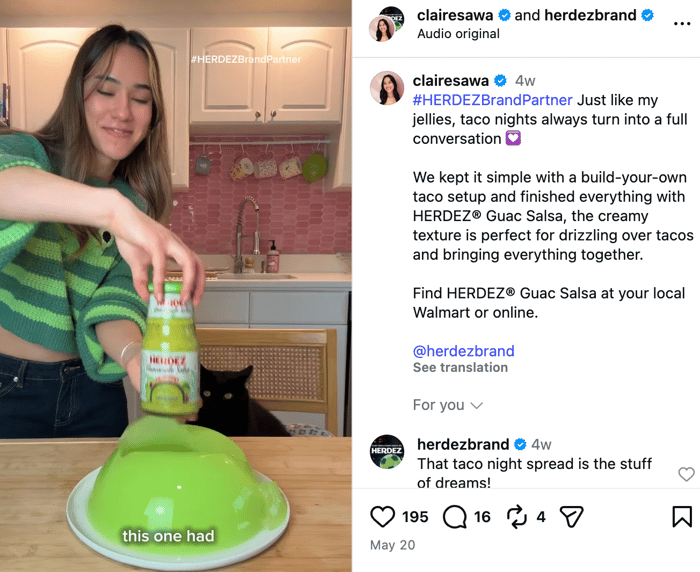
It’s clear that the brand is specific and consistent with their ad disclosure requirements because other influencers are doing the same.
The study also discovered that consumers expect influencers to use more specific language when disclosing their connections. Labels like #gifted or #thanks could come across as ambiguous and confusing.
Influencers must use clear labels like #ad, #sponsored, or #(brand)partner for better transparency. See how Isabelle Jardinn uses the hashtag #ad at the beginning of the caption to disclose her partnership with Guinness. It also helps that it’s a Collab post with the brand’s official handle.
Speaking of Collab posts, many social media platforms now offer built-in tools to disclose brand partnerships. The study found that platform-specific labels like “Commission Paid” on TikTok and “Paid Partnership” on Instagram are the most effective tools to disclose connections.
Make the most of these so there’s no mistaking whether a post is branded content or completely organic. When you use these platform labels, you have more leeway to add other disclosure language further down in the caption.
See the example below from Many Jensen and Olly Wellness. The influencer created a Collab post with the brand using the Paid Partnership label. She also included the hashtag #OLLYPartner at the end of the caption, which tidies up the space for readability and is acceptable because the partnership is already disclosed at the top.
Make sure influencers are also looped in on the ad disclosure requirements for branded content. Create influencer briefs that clearly outline the rules that influencers must follow when creating content for every type of partnership.
For example, even if influencers aren’t required to use the “Paid Partnership” label for product gifting campaigns, they must still prominently highlight that a product was gifted to them. This could include thanking your brand for the free product at the start of the caption.
Consider sharing disclaimer scripts they can customize or reuse to reassure the audience that although the product was gifted, the influencer’s opinions are their own.
On that note, encourage influencers to share their honest opinion without being swayed by the gifts they got for free.
Even with strict disclosure rules and clear influencer briefing, some creators might still leave out certain labels. Whether it’s intentional or accidental, brands need to stay on top of these missing disclosure tags.
You can’t manually go through every piece of influencer content, especially for large-scale campaigns with hundreds of posts across multiple platforms. That’s where automated tools like Influencity’s content tracking feature come in. This automatically pulls influencer content once it goes live, so you can track every post in one place.
You can quickly review whether the post contains necessary disclosure tags and fix issues with missing or incomplete labels.
/campaign-reports-hero-image-composition-content-tracking-reports%20OPT.webp?width=800&height=500&name=campaign-reports-hero-image-composition-content-tracking-reports%20OPT.webp)
Use the following quick reference guide on the biggest do’s and don’ts for disclosing brand partnerships.

Consumers today expect authenticity and transparency. Failure to disclose of any brand relationship could lead to loss of trust, which ultimately affects brand credibility. Make the most of the tips and best practices I shared above to maintain transparency through proper ad disclosures in your influencer partnerships.
A material connection is any relationship, affiliation, or financial tie that could influence an endorser’s opinion of a product or service. Influencers are required to disclose these connections, so consumers can evaluate if an endorsement is truly genuine or influenced by an incentive.
Branded content refers to any piece of creator content that features or is influenced by a brand in exchange for compensation. This includes content for which influencers receive monetary payment or free gifts in exchange.
Influencers are required to disclose any relationship they have with a brand for which they receive something of value, such as monetary compensation, perks, or free gifts. The disclosure must be prominent and clear, with specific language like “sponsored” that’s visible at the beginning of the caption.
Brands could be liable for influencers failing to disclose material connection. On the legal side, this could result in fines and sanctions as well as content removals. Additionally, non-disclosure could come across as shady and misleading, which will ultimately impact brand reputation.






%20and%20How%20Can%20They%20Benefit%20Your%20Brand%20article.jpg?length=628&name=What%20Are%20Key%20Opinion%20Leaders%20(KOL)%20and%20How%20Can%20They%20Benefit%20Your%20Brand%20article.jpg)


.png?length=628&name=Pop-up%20image%201200%C3%97800@1x%20(1).png)