Most people think a talent agent is someone who takes ten per cent and takes your calls. Then they sign with the wrong one, and find out the hard way.
I spend a lot of my time around influencers, creators and the people who represent them, so every single time I get the chance to sit down with Alex Segal, Managing Director of InterTalent, I don't want the polished version. I wanted the working version, what he looks for, what he refuses to do, and what he would tell an assistant who wants his job one day.
We ended up with two long recorded conversations, plenty of laughing, and more practical advice than I could fit in one article. So I have organised it as ten qualities. Each one comes with something you can try this week.
So, if you wonder what makes a great talent agent, it's basically someone who takes responsibility for a client's livelihood, can sign and sell, has real taste, does the homework on who will actually buy, stays calm when deals collapse, and keeps doors open after a no. Mentors, creative partnership, a strong identity and honest transparency turn a good agent into a great one.
Alex was appointed Managing Director of InterTalent in 2020, after eight years at the agency. He is the youngest MD in the company's 30-plus-year history. InterTalent is one of the UK's leading talent agencies, working across scripted, unscripted, comedy, digital, gaming, live events and brand partnerships.
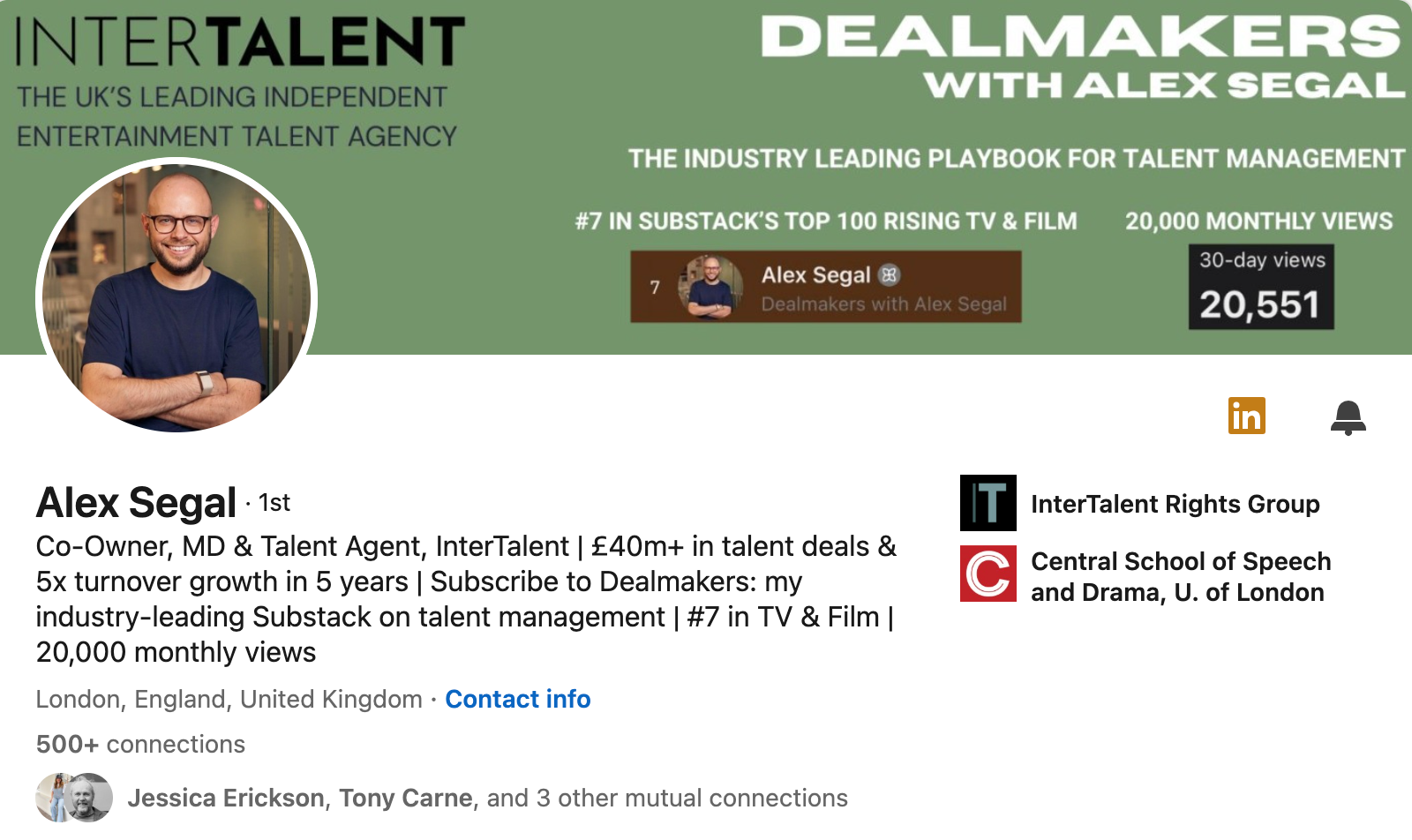
He also writes Dealmakers with Alex Segal, a Substack that explains the realities of the job, read by people at the BBC, ITV, Netflix and other major entertainment companies. He told me his clients include Francis Bourgeois on Amazon's The Grand Tour and Vinnie Jones on Netflix's The Gentleman. He started out as an assistant, on a desk that looked after names such as Daniel Radcliffe and Liam Neeson, and he trained in theatre before moving into representation.
In short, he has seen the job from the assistant's chair, the signing table and the boardroom. That is why his list is worth stealing.
I asked Alex why responsibility sits at the top of his list instead of "commitment". Commitment matters too, he said, but it is different, "I think responsibility, because it's not a game." His point is that this industry is fun, glitzy and glamorous, and the seriousness of saying "I'll represent you" can get forgotten.
He learned that early from his former boss, who represented actors like Daniel Radcliffe and Liam Neeson. Here is what she told him, "When you say to somebody, 'I want to represent you. Join me,' that's not a joke. That's a serious thing to say to somebody." Then he made it concrete:
"We are fundamentally responsible for somebody's income, and that income isn't just them. It can be their partner, it can be their children, it can be their car, it can be their mortgage or rent."
And he was just as clear about clients you no longer believe in:
"You're playing with somebody's life a bit... to just keep them on your books just in case someone calls, or because you haven't really got the heart to tell them, is actually not fair."
What you can promise, he told me, is not results but seriousness: "I will take this seriously. I'm not gonna muck about with this."
Try this:
Alex was blunt, talent agency is a sales job. You have to convince another human being to trust you with their business, in the same way they trust a lawyer, a doctor or a football manager. And you need great clients, because without them an agent is effectively redundant and cannot get calls returned.
"We're in a sales job. You can be the best negotiator of all time, you can have the best relationships, you can be the most creative agent that's ever walked the earth, but if you haven't got any clients, then what's the point?"
We agreed that contract knowledge can be taught, while charisma is much harder to teach. What you can do is give it more practice.
Try this:
Of all the qualities, Alex called taste the most overlooked and the most vital. For him it means sticking to your own principles about what is thrilling and creative, and not chasing follower counts, job volume or whatever bandwagon is passing.
"Taste is not 'They have a million followers, so I like them.' Taste is not 'They get lots of jobs, so I like them.' And taste is definitely not 'So-and-so tells me that they're really cool, so now I like them.Having taste is really your credibility and calling card as an agent."
At InterTalent, the signing process uses an eight-point tick list for both developing and established talent. A potential client has to satisfy at least five of the eight to be signed. The rule I love is the structure, a clear checklist keeps your gut honest without replacing it.
Here is a starter version you can adapt. The criteria are mine, not InterTalent's, so treat it as a template for your own.
|
# |
Question to ask |
Yes or no |
|---|---|---|
|
1 |
Do they have a distinct point of view I can describe in one sentence? |
|
|
2 |
Does their work give me a genuine thrill? |
|
|
3 |
Is there real audience pull, not just a big follower number? |
|
|
4 |
Are they ambitious, and do they bring ideas of their own? |
|
|
5 |
Are they professional and good to work with? |
|
|
6 |
Can I name at least three buyers who would want them? |
|
|
7 |
Do their collaborators work with them again? |
|
|
8 |
Can I add something they could not do alone? |
Rule to copy: sign at five or more yes answers, and write down why before you say yes. If you are working with creators, check the audience behind the number too. Platforms like Influencity can help you look at audience quality and engagement, so a big count doesn't fool you.
I asked how an agent makes sure buyers exist for a client's work. Alex's answer, rigorous homework. Selling needs buyers, so you phone people who have worked with the candidate and ask whether they are really in demand and pleasant to work with. Follower counts and surface data are not enough.
His biggest red flag is a long CV where the person has never worked with the same collaborator twice. A long list of one-off projects can point to behaviour problems, like being late or difficult.
"I look at this long list and I'm like, 'You've never worked with the same person twice.' So what that tells me: big red flag... When I see somebody that might have a smaller resume but continuously works with the same people, I get more comfort from that, because to be rehired is a seal of approval."
Try this: the three-call check.
Alex said deals almost never run in a straight line. Big ones fall apart several times before they close, so an agent needs thick skin, patience and a calm voice. Panic loses deals.
He also made a point that is easy to miss, know your client's bottom line and boundaries before you sit down. A client who is willing to walk away gives you the most leverage you will ever have.
"When a client says to you, 'I really want to do the job, but I am very, very happy, and I mean it, to walk away if it doesn't hit certain standards,' as an agent it gives you the ability to really go for it, because you're not messing around."
Try this: the pre-negotiation card. Before every negotiation, write four lines on a card.
Tip: Agree line three with the client in advance, so you are never improvising a walk-away under pressure.
This is my favourite lesson, because it is about strategy and patience, not persuasion. Alex starts from a simple assumption: a "no" is almost never permanent. People's circumstances, teams and priorities change, and the person who said no today may be looking for exactly what you offer a few months from now.
So his rule is to stay in "second position". In practice, that means three things:
"I think it's also important how you leave things."
He also pointed out that the British habit of being overly polite can work against you, compared with the more direct style you see in Los Angeles. Being direct and being gracious are not opposites, you can say plainly that you would love to work together, and still be warm if the answer is no.
The payoff is timing. You can't control when someone is ready to move, but you can make sure you are the first person they think of when they are.
Try this: the second-position routine.
Alex relies on a small network of mentors, his chairman, a business coach and experienced peers. He uses them to review decisions and to ask questions. I said asking for a second opinion is a sign of maturity, and that people with less experience often try to look as though they already know everything. He agreed, and said he now tries to help younger colleagues avoid the mistakes he made himself.
"Maybe some people think that's a weakness nowadays, that they have to rely on others. That's being mature... Asking for help, asking for a second opinion, that's someone who has already formed their opinion. When you have no experience, you are constantly trying to prove yourself, how much you know, how much you have done, and they think that that's a weakness."
This matters more than it used to. Alex and I talked about how apprenticeships are disappearing, and about how assistants can no longer learn by listening in on phone calls, because deals now happen on WhatsApp and email.
Try this: build your personal board.
In the days of Elvis and Marilyn Monroe, Alex pointed out, agents were purely dealmakers. Over the past decade that has changed. Agents now co-develop and design projects with their clients, and act as creative partners.
"In the last 10 years, agents have become creative partners with their clients. They help develop ideas. We help format ideas. We come up with our own ideas. Part of what we're expected to do is not just do a deal, but design the project... There is an expectation now that your agent is your creative partner, and I think it's exciting, because you're not just doing emails and whatnot. You're building something."
The industry has not fully caught up. At events like the Edinburgh TV Festival, producers still tend to overlook agents on panels. That is also an opportunity, the agents who bring ideas, not only offers, stand out.
Try this: the idea a month rule.
Alex told me he turned down job offers from his current company twice before accepting. As an assistant he had access to huge names, and it was hard to let go of that identity and lifestyle. The turning point was realising he had to build his own roster and wave his own flag, because borrowed prestige is not the same as earned credibility.
"You have to earn your place... Handouts aren't really what it's about. And I probably wouldn't be a very good agent if I got handouts."
Try this: the roster audit. Write down the clients you would still have if your boss left tomorrow. If the list is short, set a target for how many you will sign yourself this year, and start with the three people you already admire.
Alex is open about being criticised for an article titled "How to solve a problem like bad agents", which argued for regulation of the industry. His point is simple. In a first meeting, the client is questioned at length about their ambitions, and the agent is rarely questioned at all. He told me agents often say their "books are closed" when they just don't want that person, and he uses his platform to explain things like that plainly.
"A friend says to me, 'I wrote into this talent agency and they said their books were closed. What does that mean?' And I say, 'They don't want you.' There's no such thing as 'my books are closed.' If Kylie Minogue or Madonna turned up tomorrow, are their books closed? Absolutely not."
He also worries about talent trying to represent themselves, which he compared to doing your own surgery or legal defence.
Try this: invite the questions. At the end of your next first meeting, say: "Now it's your turn. Ask me anything about how I work, who I represent and how I get paid." Then answer honestly, including what you are not good at.
If you are the one choosing an agent, ask these five questions:
You don't need to do all ten at once. This plan puts one habit in each week.
|
Week |
Focus |
Action |
Done when |
|---|---|---|---|
|
1 |
Responsibility and taste |
Write three pitches per client, and draft your own signing scorecard |
Every client has three pitches, and your scorecard has eight questions |
|
2 |
Homework and negotiation |
Run the three-call check on your next prospect, and fill in a pre-negotiation card for your live deal |
One prospect checked, one card agreed with the client |
|
3 |
Second position and mentors |
Send warm notes to everyone who said "no" recently, and book your three mentor slots |
Notes sent, three slots in the calendar |
|
4 |
Ideas and transparency |
Take one unrequested idea to each client, and end your next first meeting with "your turn to interview me" |
One idea per client, one meeting run the new way |
|
Quality |
Score (1 to 5) |
One action to move it up a point |
|---|---|---|
|
1. Responsibility |
||
|
2. Sales and charisma |
||
|
3. Taste |
||
|
4. Homework on buyers |
||
|
5. Composure in negotiation |
||
|
6. Second position |
||
|
7. Mentors |
||
|
8. Creative partnership |
||
|
9. Own flag |
||
|
10. Transparency |
Pick your two lowest scores and work on those first. Re-score in 90 days.
Since my day job is content, I couldn't leave without asking how he keeps Dealmakers going alongside running an agency. His system is worth copying, whatever you do.
If you want to learn more about Alex's vision and how he manages talent, you can also check out our recent webinar, From Creator to Founder.
What struck me most about Alex is that none of this is secret. It is responsibility, preparation, taste and patience, done with consistency. The part that is rare is doing it every day, and being honest enough to ask for help.
A great talent agent takes responsibility for a client's livelihood, can sign and sell, has genuine taste, researches who will buy, stays calm in negotiations, and keeps relationships alive after a rejection.
A talent agent finds and signs clients, negotiates deals on their behalf, and builds their career. According to Alex Segal, agents have also become creative partners who help develop projects with their clients.
Look at their other clients and the work those clients get. Speak to people who deal with the agent every day, and check whether the agent brings ideas, not just offers. You can also ask them directly how they work, who they represent and what they would do in your first 90 days.
The best ones use a structured scorecard to back their instincts. Alex's agency uses an eight-point tick list and signs people who meet at least five points. They also check buyer demand and whether past collaborators would work with the person again.
It means staying friendly and visible after someone says no, without taking it personally, so you are the first call if their situation changes.
A long CV where the person has never worked with the same collaborator twice, according to Alex. It can signal difficult behaviour.