


Back in the early days of influencer marketing, choosing an influencer for a partnership was the least complicated step. You find an influencer in your niche, get a quick overview of their profiles, skim through their content, look at the number of followers and likes, and if you like what you see, you’ve found yourself a qualified candidate for a collaboration.
Today, however, influencer vetting isn’t quite as simple as it used to be. While the growth of the creator economy has brought a wealth of benefits for both businesses and creators, this booming industry also attracts plenty of bad actors. The rising competition in the creator economy, coupled with today’s technological advancements, has made fraudulent activities more rampant and harder to detect. So brands looking to invest in a paid collaboration can no longer trust the numbers on a creator’s profile.
If the search for a credible influencer in a sea of bots and fake influencers has been causing you terrible headaches, this piece is for you. In this guide, we will explore the bot epidemic infecting our digital landscape and devise a practical vetting checklist to protect your brands.
Social media has become a powerful marketing channel. Brands of all sizes are investing a chunk of their marketing budget into influencer marketing, and justifiably so. If you play your cards right, an influencer collaboration can bring in upwards of 5x your total investment. However, this rise in value means you have to up your budget, and small, avoidable mistakes easily compound into expensive disasters.
Picture this: you’ve partnered with an influencer whose performance data shows promise. You pay a large flat fee, in line with the industry benchmark, and wait for results. The results come, and you see no measurable returns. The cause? You missed one simple step: checking whether the numbers on the creator’s profile are credible.
As it turns out, out of the 100K followers and impressive 6% engagement rate, only a small fraction came from real human beings. So your entire financial and resource expense goes down the drain.
Additionally, since most platforms equip their algorithms with sophisticated bot-detection technology, posts from influencer profiles with high volumes of suspicious activities will likely be suppressed. This makes it more difficult for your campaign content to organically reach real users when you partner with dishonest influencers.
Typically, influencer pricing is either follower-based or performance-based. Either way, both these metrics can be artificially inflated, causing you to pay more than you need to. Even if a creator has a substantial amount of real followers, they can use fake followers and engagement to manipulate their fees.
For instance, an influencer with 80K real followers can buy 50K fake followers to boost themself from micro-tier to mid-tier. With tier-based compensation models, the difference between a $500 flat fee and a $2000 flat fee can be a few thousand followers. Hence, the risk of overpaying is still a critical concern even if the creator’s real followers outnumber their fake followers.
There’s also the risk of engagement manipulation. As the influencer marketing industry increasingly shifts toward performance-based compensation models, engagement rates largely determine how much a creator gets paid. With such frameworks, it’s essential to get an accurate reading of the engagement data to ensure fair compensation. Today, many profiles use bot accounts and engagement pods to fraudulently boost engagement, making it risky to blindly trust any engagement data.
.webp?width=700&height=438&name=analyze-influencers-slider-tabs-instagram-image-composition%20(1).webp)
As someone whose brand perception and purchase decisions are heavily influenced by social media, whenever I come across a promotional post from a profile I don’t trust, my brain instantly flags the brand in question as ‘untrustworthy’ and files them under ‘brands to avoid’. And I am not alone in this.
The power of influencer marketing lies in the bond of trust between creators and audiences. Thus, the credibility of your creators directly impacts users’ perception of your brand. When you associate yourself with creators whose profile and output attract suspicion, this lack of confidence naturally transfers to your brand’s name and reputation.
Given the risk that a single mistake can leave a costly, lingering stain on your brand’s image, doing your due diligence in assessing influencer credibility is non-negotiable for brand safety.

Even though engagements can be manipulated, a good number of disingenuous influencers stop at purchasing fake followers. Since these bot accounts serve a single purpose – artificially inflating a profile’s follower count, they never actually interact with posts. So, for such types of fraud, the follower-to-engagement ratio will be a clear giveaway. Before moving on to more intensive steps, you can get a good head start by filtering out profiles based on the most obvious signal – the engagement rate.
The days of scoring influencers solely on follower count are over, and fake influencers are evolving along with this shift. When engagement rates alone fail to tell the full story, the comment section reveals a wealth of information that numbers cannot convey.
Take a look at this comment section under a certain Instagram post, for instance:
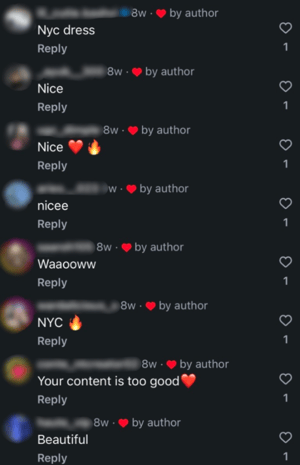
Notice something interesting?
Every comment seen here follows a certain pattern: a generic (mostly one-word) compliment or remark that doesn't mention anything related to the actual content. Since emojis and vague compliments like ‘nice’ or ‘beautiful’ can be repeated across almost every piece of content on social media, these types of comments are ideal for bot farms and engagement pods. Looking at this example, there is no indication that any of these users actually watched the reel.
A good trick to distinguish an organic comment section from a doubtful one is to ask: “Can the comment section alone tell you what the post is about?”
To illustrate, let’s compare the above example with the comment section under creator @niamhhadkins’ latest post.
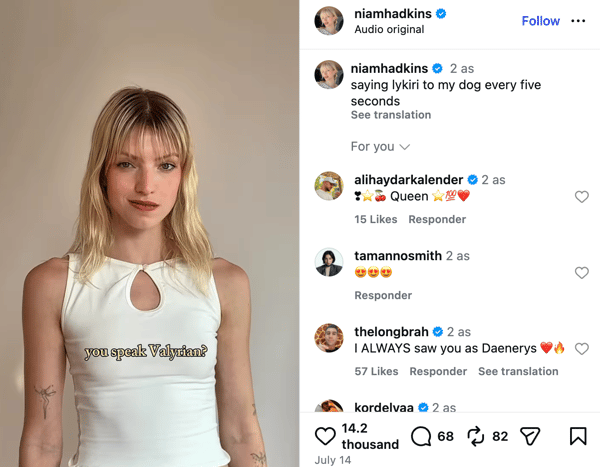
Since she’s lip-syncing to an audio from Game of Thrones in this reel, most of the comments under this post are related to the show.
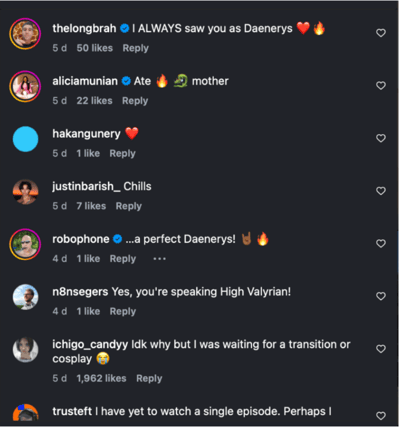
With remarks such as “a perfect Daenerys” and “Yes, you’re speaking High Valyrian”, anyone who’s familiar with the show wouldn’t even have to watch the reel itself to know what this post is about. The same cannot be said for posts flooded with generic comments.
Not every user will feel like pouring their hearts out or leaving walls of text under an Instagram or TikTok post; many might even think that an emoji or one-word comment suffices. So, you can expect to see a good mix of generic comments with relevant and meaningful remarks under any organic post. However, a comment section filled with nothing but emoji spam or generic comments is an immediate red flag.
The follower growth curve and engagement history of a creator’s profile can reveal a lot about their credibility.
With organic social media follower growth, you typically see a gradual and consistent curve over time. When there are spikes in a creator’s growth chart, there’s usually a good explanation behind it. Was the sudden uptick caused by a viral post? Did they make an appearance or get mentioned in a bigger creator’s post? Cross-referencing a profile’s growth curve against their engagement and post history will give you the full story.
On the other hand, artificial follower growth will show abnormal growth curves with sharp rises that cannot be attributed to any particular content or event.
Another noticeable tell is the location of their audiences.
Before you collaborate with an influencer, make sure to analyze the geographic distribution of their audience to detect bot hotspots or demographic misalignments that stand out.
While multiple bot farms operate worldwide, certain countries contribute more bot traffic than others. Additionally, any significant misalignment between an influencer’s target market and their demographic data should raise some alarms.
For instance, if a UK-based creator’s audience demographics show 60% in misaligned regions such as Southeast Asia, that is not a good sign. Leaving aside the risk of fake followers, such substantial mismatches will fail to generate meaningful leads, even with authentic engagement.
So, analyzing a creator’s audience demographic serves two critical purposes: scanning for fraudulent activities and ensuring audience fit.
Whenever you publicly associate your brand’s name with a creator, you instantly open the door to potential reputational risks. So, aside from fake followers and inauthentic engagement data, there are several brand safety risks to watch out for. Once a creator has passed all authenticity checks and provided verifiable engagement data, make sure to vet their content and comment sentiment to ensure brand alignment and protection.
Here’s a hypothetical scenario: you’re a sustainable brand with an established brand identity around environmental awareness. You already have a loyal community of audiences who strongly resonate with your message. But in an attempt to expand your reach, you launch a campaign with a certain macro influencer. However, you missed one crucial step during the vetting process and chose one with a history of promoting non-eco-friendly practices. Backlash ensues, the campaign bombs, and you lose your target audience’s trust.
With such missteps, you not only fail to get your message across to new audiences but also risk losing your established customer base. Hence, even after you’ve verified a creator’s authenticity, scanning their profile for any potential controversies and misalignment risks saves you from costly, avoidable mistakes.
While most social media platforms provide surface-level metrics such as follower counts and engagement data, these numbers alone cannot provide real insights. To ensure due diligence while vetting influencers for collaborations, you have to consult additional data outside native metrics. Influencer marketing platforms solve this problem with additional insights and smart data-driven tools for filtering out inauthentic and risky influencers.
Influencity, for example, offers all the features you need to follow every point from the above checklist.
Calculating the engagement rate of a single piece of content is easy, but manual calculations fall short when you are tasked with assessing engagement at scale.
While native performance data provides the figures you need to calculate engagement rates, this approach isn’t practical for vetting multiple influencers. Alternatively, Influencity provides automated engagement calculations for every candidate, saving you considerable time and resources.
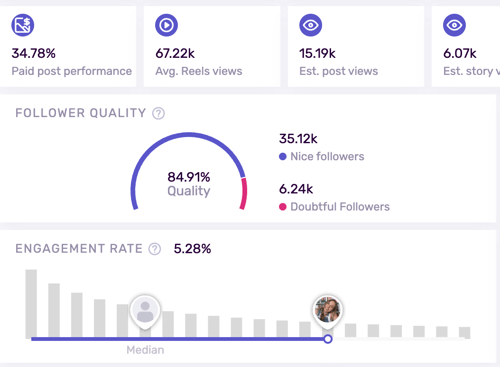
Influencity facilitates your vetting process by assessing an influencer’s audience to accurately assign an audience quality score. When you analyze a creator’s profile, this feature automatically sorts their followers into two categories: nice followers (real people) and doubtful followers (inactive or bot accounts).
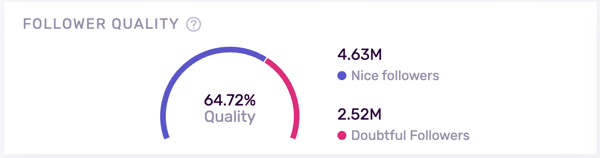
The ratio between these two categories determines the quality of a profile’s audience. This feature eliminates the need to manually review an influencer’s follower list to detect fake followers.
Typically, you can look for an audience quality score of at least 80% to identify credible followers. The ‘only credible accounts’ filter simplifies this by filtering out accounts with an audience quality score below 80% from your results.
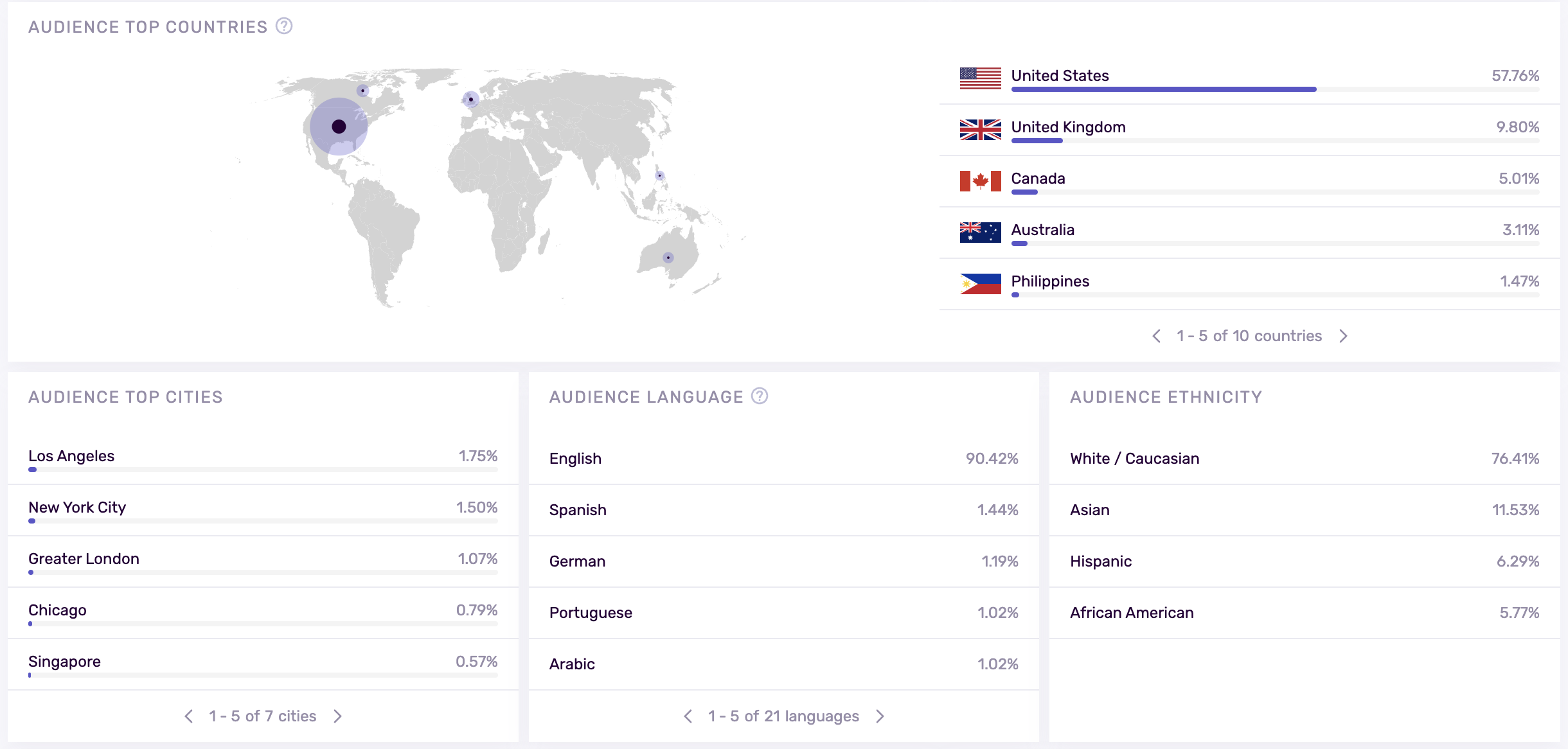
Native metrics show you the creators’ performance data; Influencity reveals who their audiences are. With comprehensive data of an influencer’s audience, including age, gender, and most importantly, geographic location, you can easily assess creators' audience demographics to determine whether they will be the right fit for your brand.
You can also examine the growth chart of a creator’s profile through Influencity.
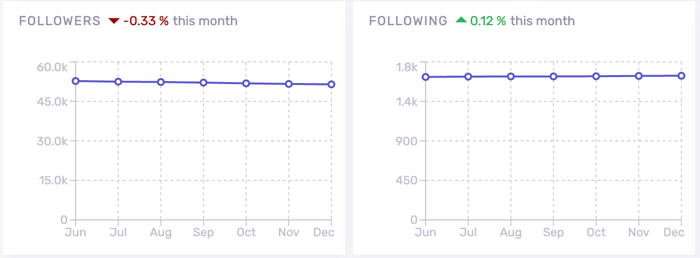
By scanning for irregularities or concerning growth spikes on this chart, you can easily detect most cases of artificial follower inflation.
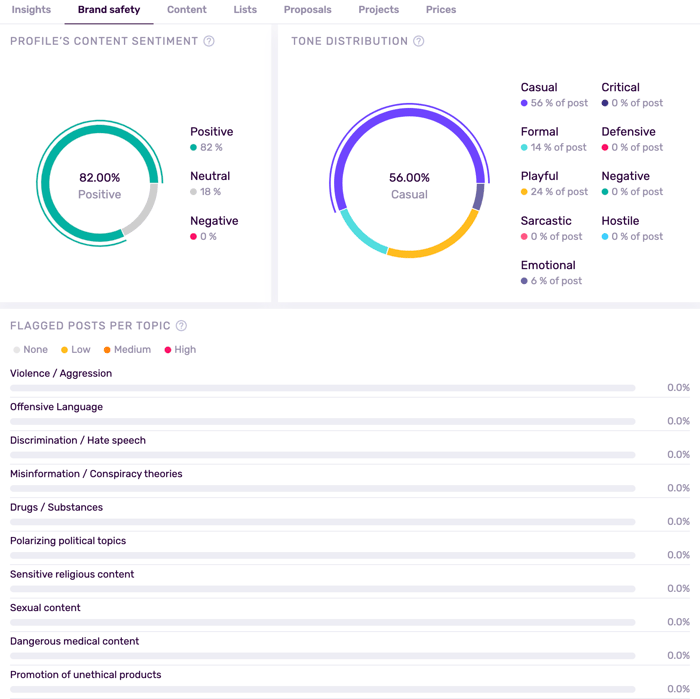
Influencity ensures brand safety by analyzing influencers’ profiles in two layers:
This analysis scans the captions and descriptions an influencer posts to detect the tone and topic of these texts. By outlining the tone distribution of these posts, flagging potentially sensitive topics, and analyzing the risk level of every detected theme, this feature gives you a clear overview of the creator’s content without you ever having to manually analyze their profiles.
Audience sentiment analysis tracks and examines users’ reactions to assess the creator's reputation.
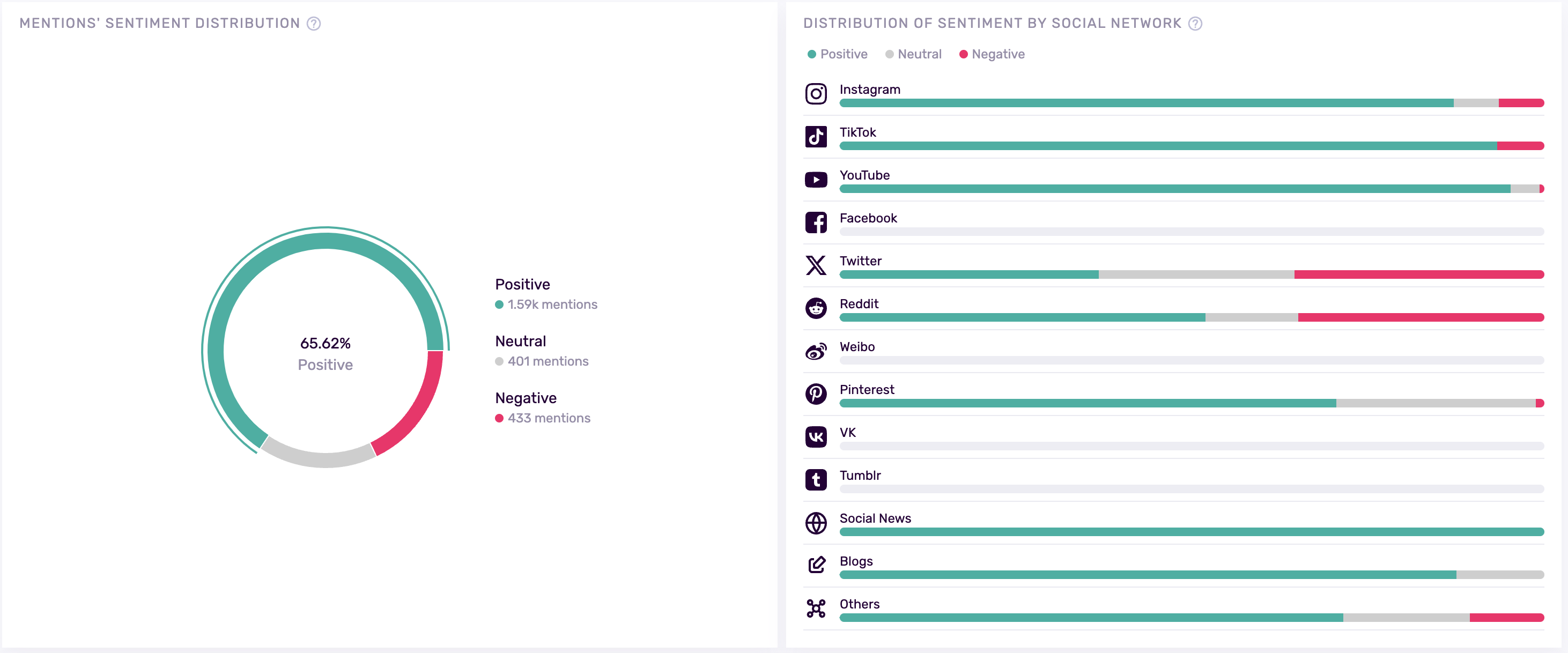
In addition to breaking down these reactions into positive, neutral, and negative, this feature provides a clear timeline of audience sentiment, giving you a reference source to decipher the causes behind these shifts.
Conclusion
With the influx of bad actors in our current digital landscape, assessing influencer credibility and ensuring brand safety have become increasingly complicated.
Since manual vetting measures are no longer practical for our current landscape, use Influencity’s influencer analytics to avoid wrong partnerships that turn into costly fiascos.
Bot farms are coordinated networks of devices or software centrally controlled and automated to mimic human activity. While these bot farms can be used for legitimate purposes, they are primarily used by malevolent parties to artificially generate traffic and manipulate social media algorithms.
Engagement pods are private groups where multiple users band together to interact and engage with each other’s content. Although not as malicious as purchased engagements, misleading data muddy performance metrics and often gets penalized by algorithms once detected.
Brand safety refers to a set of measures and tactics employed to protect brands from reputational risks, misrepresentations, or controversies.
Sentiment analysis goes beyond numbers to analyze what audiences have to say about an influencer or a piece of content. You can use this to vet influencers on reputational safety and brand alignment.
Beyond native social media metrics, influencer marketing platforms like Influencity provide comprehensive insights to vet creators from multiple angles.










%20and%20How%20Can%20They%20Benefit%20Your%20Brand%20article.jpg?length=628&name=What%20Are%20Key%20Opinion%20Leaders%20(KOL)%20and%20How%20Can%20They%20Benefit%20Your%20Brand%20article.jpg)






.png?length=628&name=Pop-up%20image%201200%C3%97800@1x%20(1).png)