

The concept of an influencer is, by now, very well-known. What started off as a novel approach in the world of marketing is now a fully established and effective form of advertising, if done well.
Every day on social networks, we see influential people collaborating with brands through their publications and sharing content with their followers, but in the majority of cases, these campaigns are focused towards the final consumer.
So, what happens when your business’ target audience isn’t the final consumer, but rather other companies? Does B2B Influencer Marketing exist? And if it does, is it effective?
The answer is yes! Albeit with certain nuances. With B2B Influencer Marketing, it’s not about looking for someone with a big audience in terms of quantity, but someone who is able to inspire confidence and whose reputation means that their recommendation is sure to be taken on board by key decision-makers from the business world.
These are the basic principles of B2B Influencer Marketing. What to find out more? Keep reading!
A B2B Influencer must be able to inspire confidence and have their recommendation taken on board by decision-makers from the business word
The aim of B2B Influencer Marketing is to attract and facilitate business between the company that has launched the campaign and other companies who are potential clients, all thanks to the influencer. In practice, that usually means working with trusted industry voices such as consultants, founders, analysts, subject matter experts, or niche creators who already have credibility with the people involved in a buying decision.
For that reason, selecting the right B2B influencer is crucial and it’s important to refine the search in order to find the right person for each campaign. The goal is not just visibility. It is to build trust with the right audience and move potential buyers closer to consideration.
The concept of a B2B influencer is different to that of a B2C Influencer. For example, metrics such as the number of followers will not be looked at in order to make a decision. Business to Business Influencer Marketing isn’t a question of quantity, but quality:
A brand influencer does not need to have a large audience, but they do need to be well-connected with the right people and be someone whose judgement is respected.
In order for these campaigns to work, it’s of the utmost importance to pay attention not only to the message that the company wishes to transmit, but also the issues in which the person who is transmitting them is involved.
The company which launches the campaign must have clear values and a clear message that they wish to transmit. In order for the message to be effective, it must be in line with the influencer’s motives. Only then will you achieve maximum implication from the influencer and ensure that the message will be successfully transmitted.
This is why B2B influencer marketing often works especially well in formats such as LinkedIn posts, webinars, podcasts, expert roundtables, newsletters, and co-created reports. These formats give the influencer room to add perspective and credibility, not just exposure.
In order for the message to be effective, it must be in line with the influencer’s motives.
A simple way to think about it is this: in B2C, influence often helps drive attention and desire. In B2B, influence helps reduce risk and increase confidence. That is what makes the right creator or expert so valuable when buyers are comparing vendors, researching solutions, or shortlisting partners.
The difficulty of finding a B2B Influencer stems from the fact that it tends to mean looking for people with great work-related responsibilities who therefore don’t have much time to actively take part in these types of campaigns on a regular basis. That is why B2B influencer marketing often works better when brands adapt the format to the influencer, rather than expecting the influencer to act like a full-time content creator.
Today, B2B influencer marketing is no longer limited to a few isolated campaigns. It is most commonly seen in formats where expertise and credibility matter, such as LinkedIn posts, webinars, podcasts, newsletters, panel discussions, and co-created reports.
LinkedIn remains one of the strongest channels for this kind of collaboration because it is where many professional conversations already happen. But it is not the only option. Guest content, expert roundtables, industry events, and creator-led webinars can also work well when the goal is to reach decision-makers in a credible way.
In other words, B2B influencer marketing tends to work best where the content feels useful, informed, and relevant to a professional audience, not just visible.
The key for success with B2B Influencer Marketing campaigns is to clearly define the steps to take and develop each one in the correct manner. So easy, yet so difficult, right?
To give you an idea of what you should do to launch a successful campaign, here are some tips:
It’s hard to evaluate the success of a campaign if you’re not sure what you’re trying to achieve. Choose an objective and expectations in terms of the numbers you wish to achieve in a specific time frame and other more general goals that can’t be measured with the same amount of precision, but can still be beneficial, such as objectives related to improving brand reputation or image.
Now you know what you want to achieve, think about where your target audience is and which social network is best to get your message across. You don’t have to stick to just one, but you should always know where you should be concentrating your greatest efforts. Only then will you be able to maximise your investment.
We’ve already mentioned the importance of choosing your brand influencer. Don’t go with your gut; make sure you warrant the decision with data that strongly supports it. To do so, use the right tools to help you analyse candidate profiles.
Once you’ve selected the right data to analyse, you can start asking more profound questions in order to find out whether they fit in well with the brand or not, such as the following:
Make sure you choose a candidate who will provide value to the content, as well as credibility and relevance to your target audience.

It’s important to promote a healthy feeling of mutual collaboration between the brand and the influencer. Don’t make the influencer feel like an employee or a loudspeaker for your brand’s message. Instead, give them clear guidelines.
You must work side-by-side in creating the content and give them a margin of freedom with which they feel comfortable. At the end of the day, an influencer is someone who has their own way of expressing themselves and the best way to ensure the campaign is a success, is to for them to be able to identify with it.
If by the end of the campaign, contact with the brand influencer grinds to a halt, you’re missing out on much of the great potential of this strategy. Building a long-term relationship is much more beneficial than limiting it to a mere commercial exchange or a single B2B influencer marketing campaign. Stay in touch, share content and keep meeting up with the influencer. In summary, don’t just contract an influencer, gain an ally.
Analysing data is much more precise than any other form of assessment or subjective perception. The data is going to tell you exactly how your campaign fared and to what extent it was successful. You need to analyse the results and let the metrics do the talking. Only then will you be able to correct potential errors, detect merits and improve the efficiency of your campaigns.
As we’ve already seen, for campaigns with brand influencers, it’s crucial to have data that allows you to make objective decisions, correct your mistakes on time and analyse results. Today, the value of technology in B2B influencer marketing is not just speed. It is the ability to evaluate fit more accurately, keep outreach organized, and measure performance without relying on guesswork.
From choosing the right influencer to measuring the impact of your campaign, there exists certain tools on the market that allow you to contrast any type of campaign data. Modern influencer marketing platforms can help you discover relevant creators, analyze their profiles in more depth, centralize your relationships, and track campaign content more efficiently. Influencity’s suite includes Discover, IRM, outreach, and content tracking tools designed to support that workflow.
In Influencity, we know which metrics will help you score success and, with our software, the entire B2B (or B2C) Influencer Marketing process is much more simple, as you’ll always have precise data and your campaigns under control: for example, you can search and shortlist influencers, review full profile KPIs, access audience insights, and use metrics such as follower quality and brand affinity to assess whether a creator is genuinely relevant to your brand.
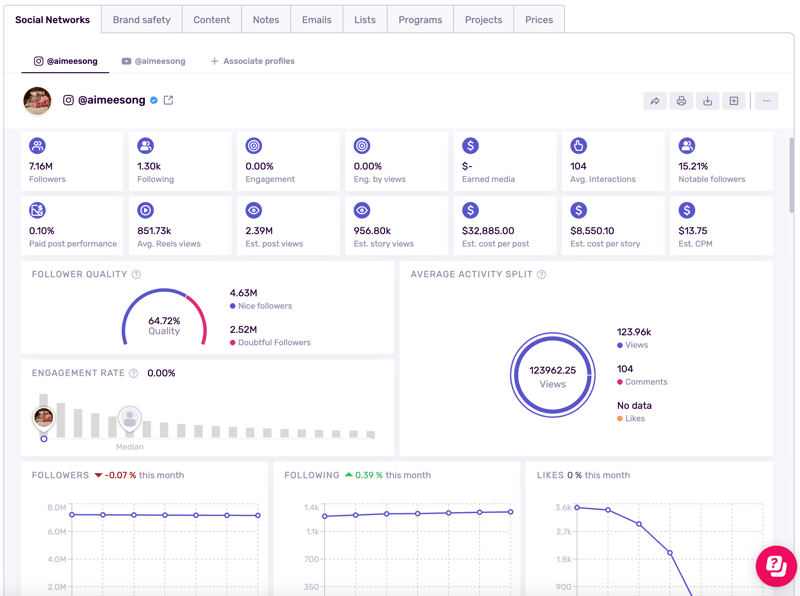
All your data organised in the most efficient way so that all you have to do is make decisions based on metrics
You can also manage communication more easily. Influencity supports outreach emails, bulk email workflows, and IRM-based communication, which is especially useful in B2B campaigns where the relationship often matters as much as the post itself.
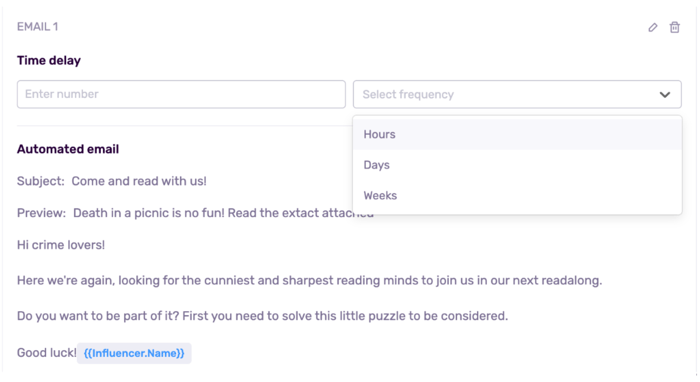
In practical terms, this means less time switching between spreadsheets, inboxes, and social profiles, and more time focusing on which creators are most likely to help you reach the right decision-makers.
Want to know more about the results you could obtain with our tool and how it works? If you are actively evaluating whether B2B influencer marketing can work for your brand, using a platform like Influencity can make the process much easier to test, measure, and scale with confidence.
B2B influencer marketing is when a brand works with trusted industry experts or creators to reach and influence other businesses.
B2B focuses more on credibility, expertise, and relevance than on large audiences or mass visibility.
LinkedIn is usually the strongest option, but webinars, podcasts, newsletters, and expert-led content can also work very well.
Look for someone whose audience, expertise, tone, and values align naturally with your brand and business goals.
Track the metrics that match your goals, such as reach, engagement, leads, brand perception, pipeline impact, and ROI.







%20and%20How%20Can%20They%20Benefit%20Your%20Brand%20article.jpg?length=628&name=What%20Are%20Key%20Opinion%20Leaders%20(KOL)%20and%20How%20Can%20They%20Benefit%20Your%20Brand%20article.jpg)




.png?length=628&name=Pop-up%20image%201200%C3%97800@1x%20(1).png)