


As the creator economy forges ahead toward unprecedented opportunities and meteoric heights, every industry player is vying to get the most out of this thriving market. With Goldman Sachs projecting a $ 480 billion creator economy by 2027, brands are rapidly increasing their influencer marketing budgets. Similarly, the creator community is also multiplying by the minute.
For internal stakeholders, this flourishing environment provides fertile ground for rapid expansion and development. However, agencies are slowly learning that leveraging this bottomless well of opportunities isn’t as simple as it may seem. Beyond the obvious steps like recruiting more creators to your talent roster and brokering more deals, there’s an art to scaling your influencer marketing operations that many agencies struggle to nail. This post will examine the operational infrastructure of some of the industry’s key players to identify what agencies need to do to operate at a similar scale.
The burgeoning influencer marketing landscape has unlocked new avenues and increased possibilities for stakeholders.
As agencies, you get access to a bigger, more diverse talent pool; you’re employing more people, which means more creatives and sets of hands working on your campaigns. Additionally, brands are increasingly aiming to strengthen their influencer marketing efforts, presenting you with better opportunities and higher budgets. Thanks to this increased access, you have all the ingredients you need to accelerate your performance and increase your output. But for whatever reason, scaling still feels extremely challenging for many agencies.

On the surface, today’s influencer marketing landscape seems like the ideal environment for accelerated growth and improved workflow, but the reality often proves quite different. As the scale of your operation heightens, so do the risks. One missed communication, a few crossed wires, and everything falls apart. You soon realize how quickly situations can go out of hand in large-scale operations. This risk often comes at too high a cost for agencies, prompting them to pull back and refocus.
In this dynamic and highly competitive environment, what exactly separates the winners from everyone else? What is the secret ingredient enabling leading agencies to break new ground and rapidly expand while others trail behind? Is it a better workforce, access to better creators, higher budgets, or exceptional skills? The answer is a lot less conspicuous than one would assume.
Imagine this: you’re about to prepare a luxurious dinner for a friend; you’ve sourced the highest quality ingredients from around the world – truffles imported from Italy, fancy artisanal cheese, the most expensive herbs and spices you could get your hands on, but before you can turn these ingredients into something delicious, there’s one crucial element you cannot overlook – the recipe. Even the most premium ingredients can’t magically come together to form a scrumptious treat; you need to follow a certain formula to make them work together. Influencer marketing operations work the same way.
When it comes to large-scale operations, top agencies have cracked the code on executing an optimized workflow without necessarily making their agents work harder. The secret sauce to these large-scale agency operations isn’t in their star-studded rosters or the volume of their workforce; instead, they rely on a carefully crafted infrastructure designed to sustain scaling.
As randomly throwing ingredients together in a pot cannot deliver an appetizing meal, agencies cannot simply source the best talents, hire the most adept agents, and broker countless deals and expect it to work. For these strong elements to take effect, they need an equally robust operational framework. This is the part many agencies struggle with.
Some agencies think that increasing the size of their workforce and talent roster is enough to keep up with their growing scale, but the functional reality is rarely that simple. Without a structured, practical recipe in place, any scaling effort is, at best, fruitless and, at worst, detrimental.
As the market grows more saturated, the stakes have only heightened. There’s increased pressure among both businesses and creators to seize the audience’s attention in an increasingly crowded digital space. Under these circumstances, influencer campaigns can no longer follow the traditional model where collaborations are treated as expendable add-ons to a larger marketing strategy.
Today, businesses are progressively shifting their focus toward retention and quality, rather than sheer volume. This shift is a welcome development for agencies as it presents the perfect opportunity to establish sustainable systems rather than strategize around volume boosts.
Historically, influencer campaigns were treated as one-off deals, with bespoke approaches for every deal. You find an opportunity, match it to an influencer, negotiate compensation, strategize, brief, deliver, then report. When a new opportunity comes, you repeat the whole process from square one. This framework has proved extremely unsustainable as the market expanded. With market saturation prompting a shift in attention toward retention and long-term partnerships, leading agencies are leveraging this trend to build repeatable frameworks that underpin all their operations.
Today’s top agencies streamline their operations through:
Since executing an effective paid media campaign requires the collective effort of countless players, every stage of the production has to be in sync with one another. Mature agencies view this cross-functionality as paramount to their campaign operations.
From the campaign ideation and content creation to distribution and post-campaign reporting, there are numerous key players running the machine of an influencer marketing campaign. Any misalignment or communication barrier between these teams can cost a detrimental setback that no agency can afford. Which is why top agencies, such as WPP and VaynerMedia, emphasize breaking down the silo barrier to encourage a seamless flow of communication and coordination.
In the words of VaynerMedia’s CMO Avery Akinenni, “True momentum comes when creative, media and strategy move as one.”
This attention to cross-functionality is the core tactic that puts these agencies above their competition in operational excellence. Treating the integration of these three facets as a powerful growth engine, top agencies leverage every discipline to methodically answer the ‘what’, ‘why’, and ‘how’ of their marketing efforts. This cooperation creates a continuous feedback loop that keeps the ball rolling. Once this system is in place, scaling becomes much less challenging.
Centralized Task Management Hubs for Enhanced Productivity
If we look at some of the biggest names leading the industry, many of them operate at an enterprise level, with employees and operations spread across the world. This scale is only manageable through cutting-edge collaboration platforms.
This parent company to top marketing agencies such as Ogilvy, Obviously, and The Goat Agency runs its operations through UHUB. This internal company equips its agents with an integrated platform for Atlassian tools like Jira and Projectrak. Through this hub, WPP offers a centralized knowledge base for all its subsidiary agencies and the hundreds of thousands of employees working under them.
In contrast to silos, where manual handoffs can create numerous communication bottlenecks and introduce human error, this centralized hub allows campaign coordinators to seamlessly input and distribute campaign strategies to relevant teams. WPP’s cross-functional workflow relies heavily on automation, real-time tracking, and communication loops powered by these collaboration tools.
Like WPP, Dentsu uses a centralized collaboration platform to strengthen its cross-functional integration. Powered by Unily, Dentsu Dot enables the global marketing giant to connect its 68,000 employees across 120 markets. This centralized Employee Experience Platform (EXP) was designed to eliminate communication bottlenecks and alignment challenges that were limiting the agency’s cross-market, multidisciplinary collaboration.
Beyond improved performance, this fluid flow of communication, streamlined task handovers, and workflow automation significantly drive employee satisfaction. After introducing Dentsu dot, the company saw a 30x increase in engagement and an 86% read rate for critical internal communications. These numbers show that robust collaboration systems don’t just serve as productivity engines but are also powerful engagement drivers within the workplace.
When agencies ensure a harmonious workflow and collaboration among teams, they can quickly capitalize on opportunities before momentum fades.
For instance, if your social media coordinator or analytics team detects a golden opportunity for brand-led paid ads, they can use these collaboration tools to communicate and coordinate with relevant teams quickly. This is especially crucial for strategies like UGC repurposing and influencer allowlisting, where organic digital content can be transformed into powerful paid advertisements.
Take the Goat Agency’s campaign for Arm & Hammer, for instance. The agency first used data analytics to identify and work with band-aligned influencers.
After detecting strong organic performance from this collaboration content, the paid media team quickly repurposed these assets for paid ads and even boosted them beyond native platforms using Amazon Ads. This swift amplification effort, built on organic social performance, produced impressive results, achieving an engagement rate that exceeds the industry benchmarks by 14%.
With an optimized communication flow, teams can work together to combine organic social performance with influencer-led and brand-led paid media to amplify the impact of digital content.
Since data drives today’s paid media marketing strategy, top agencies are skillfully integrating data engines into their workflow. From real-time tracking to data-backed budget allocations and ROI calculations, data tools provide much-needed assistance to optimize workflows.
The key to effective machine implementation is knowing where it fits into your workflow. Top agencies use data as a bridge to power the continuous feedback loop within their internal systems. However, rather than automating the entire execution cycle of their campaigns, they design adaptable modular frameworks that clearly allocate spaces for human intervention.
When you use machines to handle data-heavy tasks such as content tracking, performance analysis, and predictive modeling, you lighten the workload for your human agents. This leaves them with more room to focus on the human-centered tasks such as ideation, creative direction, strategy development, and relationship management. By designing strategic modular frameworks that champion human creativity, top agencies foster an uninterrupted workflow with minimal risk of error.
From creator discovery to briefing to reporting, integrated databases provide an essential single source of truth, ensuring a streamlined cross-functional workflow. Leading agencies use these unified hubs to:
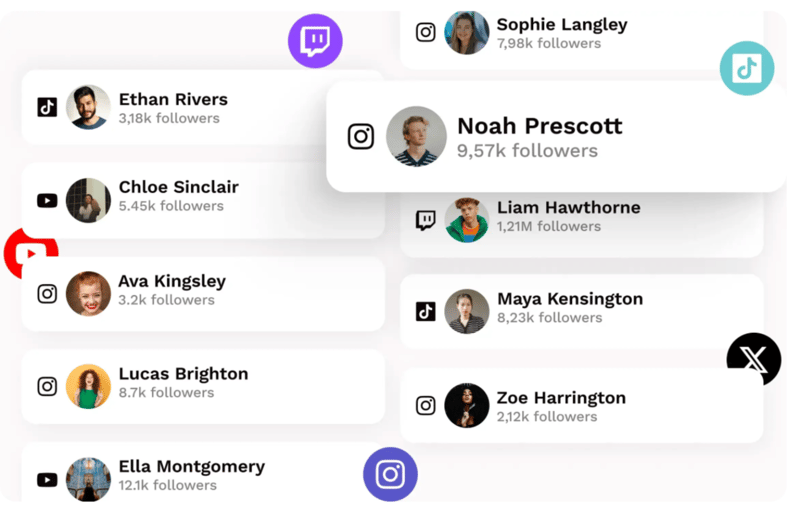
These centralized platforms allow agents to store, share, and access all creator-related information in a single database, eliminating unnecessary layers and communication delays.
Having a single repository to store these standardized, repeatable documents significantly speeds up campaign execution cycles.
Having a strong framework to optimize your internal operations is crucial, but equipping yourself with the tools to sustain it is equally important.
Even without the top-tier agency budget for proprietary platforms, agencies today can access these optimization features through campaign management platforms like Influencity. This workflow automation software is designed to foster cross-functional agency operations through centralized databases, smart communication hubs, and cutting-edge campaign monitoring and tracking systems.
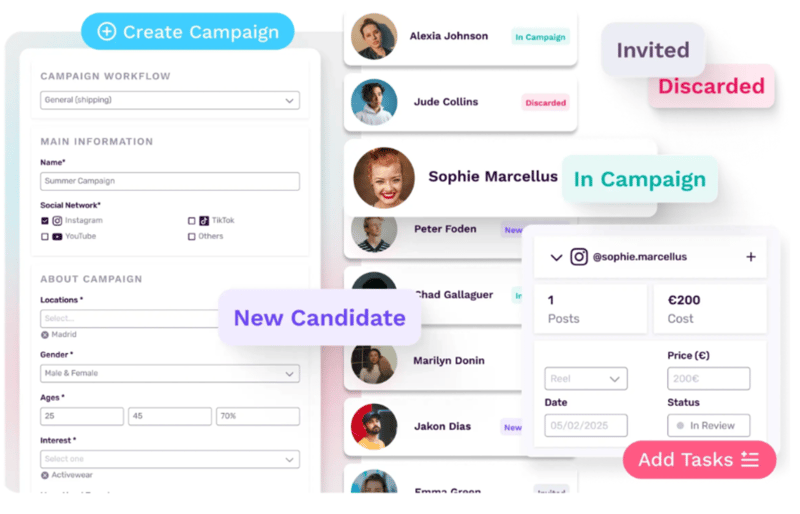
While an implementation framework sets the blueprint for operational efficiency, collaboration tools are what put that blueprint into action. With end-to-end marketing platforms, you can access every tool you need to accelerate execution and fill operational gaps through every step of your campaign implementation wheel.
Rather than treating every campaign as a separate project, top agencies build reliable frameworks that underpin all their operations. As a result, this infrastructural strength enables them to scale and execute cross-market, multi-channel campaigns effortlessly.
Agencies can use centralized communication and task management hubs to ensure harmonious collaboration between teams.
A cross-functional workflow facilitates quicker information exchange, enabling agencies to maximize impact by leveraging momentum with paid ads.
In addition to boosting productivity, collaboration tools help agents offload repetitive tasks, avoid frustrating approval cycles, and eliminate communication delays, thereby improving engagement and morale.
Influencity is an end-to-end campaign management software that consolidates all your campaign resources, including communication, performance tracking, influencer relationship management, etc., in one place, enabling seamless campaign execution and cross-functional collaboration.









%20and%20How%20Can%20They%20Benefit%20Your%20Brand%20article.jpg?length=628&name=What%20Are%20Key%20Opinion%20Leaders%20(KOL)%20and%20How%20Can%20They%20Benefit%20Your%20Brand%20article.jpg)







.png?length=628&name=Pop-up%20image%201200%C3%97800@1x%20(1).png)