


There are conversations that you pencil into your calendar, and then there are conversations that fundamentally rewrite your mental hard drive. Sitting down with Chloë Davies was entirely the latter.
When I sat down to prepare for my conversation with her, I quickly realised that trying to pin her down with a single, neat corporate title is like trying to catch lightning in a paper cup. She is currently a Growth Marketing Partner at The Unmistakables and the founder of the It Takes A Village Collective but she is also a former retail floor manager at Peter Jones, a trained chef, a community advocate, and an unapologetic advocate of culture.
During our two-part interview (interrupted only by the very real, very messy realities of parenthood and school runs), we peeled back the layers of her journey. It was a showcase in narrative framing, blending references from comic books to corporate strategy.
Amid the chat, she naturally wove in references to Peter Pan, The Matrix, and comic book superheroes. Naturally, that instantly made her a kindred spirit in my book. But beyond her brilliant use of literary and pop-culture framing, what truly earned my admiration is the raw, unvarnished humanity she radiates. We talked about marketing funnels, the messy realities of life, evolution, and what it actually costs to drive systemic change.
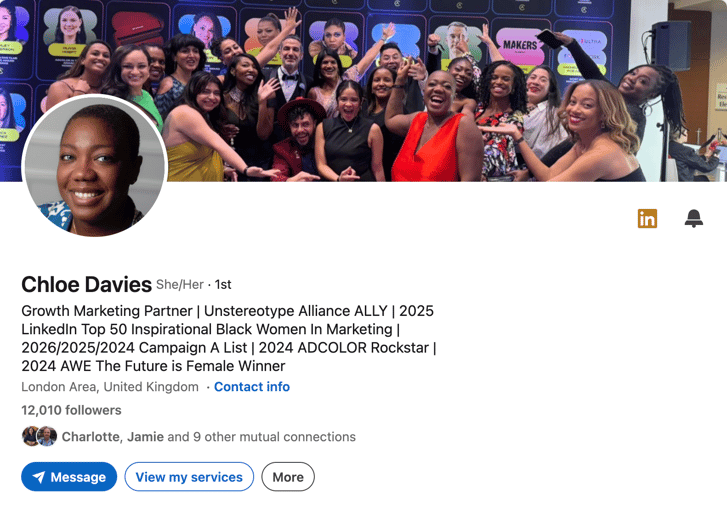
Here is the uncensored, first-person look at what happens when you stop playing by the industry’s inherited rules and start writing your own playbook.
You cannot understand someone’s vision without first understanding where they come from. Before we talked about growth metrics, funnels, or marketing strategy, Chloë and I started at the beginning, with the roots that shaped her perspective long before business entered the picture.
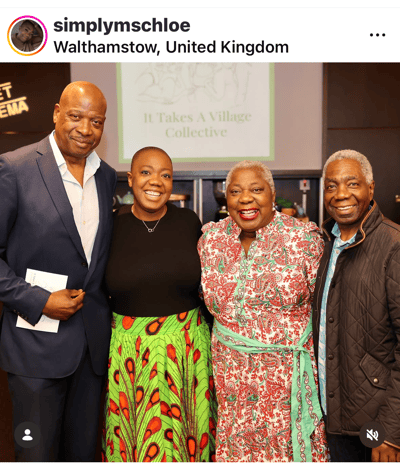
Growing up in Walthamstow, what she laughingly called the back end of civilisation in the 80s, she was granted a unique passing privilege. Because there were no strict school catchment areas then, she and her brother attended schools in the highly affluent boroughs of Kensington and Chelsea where her parents worked. From ages five to nineteen, her reality was split between Zone 4 and the Kings Road.
She was raised in a vibrant household defined by reversed gender roles long before it was culturally trendy. Her father, a designer for Carnaby Cavern, was the main child-rearer and the cook, cultivating an environment rich with the sounds of 1980s funk rock and house parties. But it was her mother who laid down the professional blueprint that Chloë would eventually follow, challenge, and expand.
Chloë’s professional debut was anything but a gentle wading into the workforce. At exactly 16 years and four days old, her parents cut off her pocket money, forcing her onto the retail floor at Peter Jones. By the age of 17, she had earned a spot as the youngest management trainee in John Lewis history.
But this isn't a standard corporate coming-of-age story, if you ever meet Chloë you’ll quickly realise nothing around her is standard. She quickly saw herself stepping into a massive shadow. Her mother was a trailblazer, having fought her way up from a Saturday girl to become the first Black department manager at John Lewis. The cost of operating in the wake of that legacy was brutally high.
To maintain professional boundaries, her mother explicitly told her, "I don't know you" when they were at work. Furthermore, the colleagues her mother had come up with were now Chloë’s bosses, and they explicitly warned her they would be harder on her precisely because of her lineage.
And she wasn't cutting her teeth in just any store. Peter Jones held a royal warrant, making it a frequent stop for society's elite, from the King and Queen of Jordan to Pierce Brosnan. The rules of engagement were razor-sharp, you were there either to be served or to be of service, and staff were strictly forbidden from taking tips or asking for autographs.
"When I started on the retail floor at Peter Jones at 16, I wasn't just a management trainee," Chloë reflected, the weight of the memory clear in her voice. "I was carrying the expectations of my family and my colleagues because of my mother's standing."
Following in the footsteps of a pioneer means the spotlight is harsher and the glass ceiling, though cracked, is still sharp. But instead of just conforming, a young Chloë challenged traditional operations from day one, introducing sewing workshops and handbag-making classes that the store continues to run to this day.
"Oh my god, it is the best people-watching experience you're ever going to have in your whole life. You learn so much about people, the characters of people, what makes them tick because you watch their behaviours."
Sadly, her mother recently passed away, but her legacy is the gravity that grounds Chloë's orbit. Her mother taught her how to work within a system and her own existence proved that the system could be bent.
While her mother’s ultimate dream was to become a department manager, Chloë knew early on she wanted to be more than that. She was the employee who infuriated traditional managers by pointing out that while one plus one makes two, so does 0.5 and 0.5 plus one.
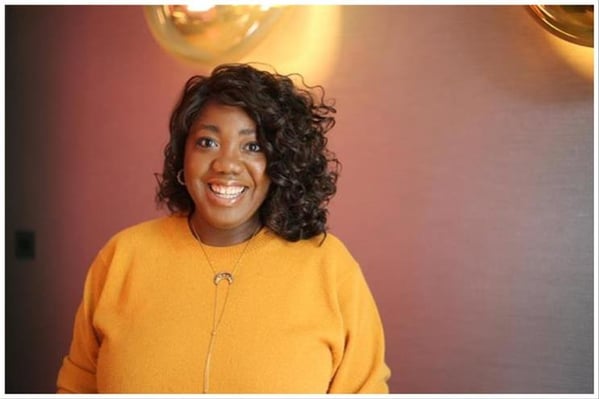
Instead of conforming to a rigid job description, she leveraged the company's incredible learning and development program, operating as a floater who was sent in to troubleshoot across various departments. She managed the Haberdashery department and completely re-engineered its offering by pitching and launching handbag-making and sewing workshops, innovations that John Lewis Oxford Street still runs today.
Chloë is admittedly someone who gets bored easily, possessing a hyper-focused, creative brain that demands constant stimulation. Before she conquered the agency world, she wanted to do music industry management, even completing work experience at Tower Records.
But her entrepreneurial grit truly shined in the kitchen. What started as a favour, baking four cakes for a friend, instantly turned into seven corporate orders and birthed a full-blown catering side hustle. Her best friend's flatmates in Notting Hill, a group she affectionately dubbed the gay mafia, became her personal innovation lab. They would gather on Tuesdays to watch RuPaul's Drag Race while acting as taste-testers for eight different cake flavours.
(This empire-in-the-making was ultimately put on hold due to a cascading health crisis, including severe PCOS, a pulmonary embolism, and a premature heart attack at just 25 years old unfortunately)
Fast forward to her current reality. Chloë operates as a Growth Marketing Partner, a title she describes as a modern label for the connective work she has been doing for a decade. Whether as Head of PR and Partnerships at myGwork, where she helped grow the business from 85 to 225 clients and win £2 million or as Head of Social Impact at Lucky Generals, she is the connective tissue that bridges wild creative vision with commercial reality.
She pulls together the Avengers Assemble of internal teams and clients. But if you want to see her philosophy of balancing emotion with hard business fundamentals in action, look at the Virgin Atlantic campaign.
For Chloë, this was deeply personal. It was an opportunity to honour her own lived experience of facing discrimination and raised eyebrows while traveling as a dark-skinned black woman. The campaign intentionally rejected actors, choosing instead to showcase the airline's diverse staff as real people.
"To have the ability to work together with a team to go 'let us show the world that you can make money but do good at the same time.' That was what that campaign was about for me... showing the heart for business."
Unsurprisingly, this move became the most successful campaign in Virgin Atlantic's history.
When we pivoted to the realities of corporate growth, and I wanted to know when she decided to rip up the traditional agency rulebook. Chloë is quick to point out that you cannot just walk into a boardroom and flip the table on day one.
"For a long time, I let my own matrix try and tell me to just do this, just behave, and you can have the life that you want," she confessed.
But playing the role of the quiet conformist in a system never designed for marginalised talent is a recipe for erasure. However, Chloë’s approach is remarkably pragmatic. She smartly strategised her move upwards. She emphasised the importance of earning a seat at the table first. You have to learn the rules to break them effectively.
"Emotion is merely a nice to have when power structures are patriarchal," she said, delivering a line so sharp it could cut glass. "You cannot build a business solely on emotion because it lacks sustainability. You have to balance that emotion with core business fundamentals."
To explain this phase of her career, she brought up a brilliant parallel from Sophia Stewart's original concepts for The Matrix. Marginalised talent is often pressured to play the role of Silas… just conform, plug quietly back into the system, and you will be allowed to live a comfortable life. But to truly win your own game of life, you have to wake up and realise you are your own Neo.
"I forgot who I was because I let my own matrix try and tell me just do this, just behave and you can have the life that you want. And then I realised, no, that's not going to actually help me win at my own game of life, nor should it. I'm trying to fit into something that was never designed for me."
The caveat? You cannot just walk in and flip the board on day one. You have to earn a seat at the table by learning how the game is played, understanding the power structures, and acquiring the necessary skills before you can rewrite the rulebook. In her eyes, true nuance and real change can only be applied when you create your own power structures.
This philosophy of combining raw emotion with hard data is exactly how she approaches her work with the It Takes A Village Collective. Chloë is currently tackling the advertising industry's diversity crisis head-on. The 2023 All In Census revealed a terrifying reality of 30% of Black and Brown respondents planning to leave the industry within 6 to 12 months due to discrimination and gaslighting. Of that group, a staggering 78% were Black women.
These numbers are terrifying. Chloë looked at this mass exodus and drew a line in the sand. Not a fuzzy, feel-good diversity pledge, but a hard, unapologetic metric, 1 in 5 people in Adland must be a Black woman by 2028.
"Representation without structural change is entirely cosmetic," she asserted. Through anchoring her mission to a strict number, she holds the industry accountable.
That’s how in response to these stats, she founded It Takes A Village with that uncompromising metric. Carrying the weight of that mission, alongside executive duties and raising two sons, is a fast track to burnout. She survived the crushing weight of leadership by fundamentally shifting her operational philosophy.
"I thought leadership meant carrying every single brick. I thought I had to be the builder, exhausted in the trenches of operational minutiae... I realised I had to become the architect. The architect designs the structural blueprint, anticipates where the foundation might crack, and empowers the builders to execute the vision".
Growth Marketing Partner is one of those titles that can sound incredibly abstract. It sits right at the intersection of culture, inclusion, and commercial revenue. When I asked her to explain her day-to-day role in the simplest terms, she gave me an analogy I will never forget.
Agencies, she noted, are often filled with Peter Pans and Lost Boys, brilliant creatives who want to fly high, have fun, and never deal with the serious stuff. Clients and operational hurdles can sometimes play the role of Captain Hook.
I'm Wendy. I want to have fun. I want to hang out just like every... But the Wendy bit is growth. It's the how do I make the messy middle work. Someone's got to be sensible.
As a Growth Marketing Partner, she operates as Switzerland. She is the connective tissue that bridges wild creative vision with hard business fundamentals, proving that you do not have to sacrifice purpose to achieve profitable, values-led revenue.
A superhero narrative isn't complete without flaws. Chloë loves comic books because the heroes are never perfect; they all have their own Kryptonite. For highly visible leaders, that Kryptonite is often the invisible load of domestic life and the intense emotional labour of community advocacy.
She faces everyday life through pragmatic self-compassion. Drawing on the philosophy of KC Davis, she reminds us that chores are morally neutral. If the laundry isn't folded because you spent your energy fighting for equity in a boardroom, you are not failing. You are just human.
"I love my brain. I love the way that I see the world... I understand what it costs people to tap into their heart magic and I just try and create spaces, places and foundations where they have the ability to be able to do that.
In full transparency, I left our conversation with the uncomfortable but necessary realisation that many of us are still trying to succeed inside systems that were never designed with us in mind. And yet her answer is not cynicism. It’s more about creativity, learning the rules, understanding the power structures and building credibility brick by brick. Then, once you finally earn your seat at the table, redraw the roadmap entirely.
There was something profoundly moving in the way she spoke about leadership, as the ability to create conditions where other people can thrive. That shift from builder to designer might be the most important leadership lesson I have heard in years.
And maybe that is the real takeaway I carried home after our conversation. Sustainable growth, whether in business or in life, is never just about scale. It is about designing environments where people can keep their humanity intact while they grow.
Chloë reminded me that the most powerful professionals are the ones who learn how to operationalise empathy without losing commercial clarity and who can sit in the messy middle and still keep moving forward.
Honestly, by the time we finished talking, I felt less like I had conducted an interview and more like I had been handed a new lens for looking at ambition itself. One that is sharper, more humane, and infinitely more sustainable.
If you are looking to audit your own professional playbook, here is what you should steal from Chloë’s methodology:








%20and%20How%20Can%20They%20Benefit%20Your%20Brand%20article.jpg?length=628&name=What%20Are%20Key%20Opinion%20Leaders%20(KOL)%20and%20How%20Can%20They%20Benefit%20Your%20Brand%20article.jpg)




.png?length=628&name=Pop-up%20image%201200%C3%97800@1x%20(1).png)